Computers have become an essential part of our everyday lives. Students are using computers daily through their need to attend online classes, play games, searching information, or do their school projects. However, most learners have never taken a moment to know what the term of Computer actually is or its origin.
Knowing a new understanding of the meaning, structure, and purpose of a computer will contribute to the development of a solid digital knowledge base. This article will be a clear explanation of the full form of a computer, definition, history, components, uses, advantages and limitations in an easy and student-friendly manner.
In India, computer education is being introduced at an early stage in schools so that children can have the necessary digital skills.

What is the Full Form of COMPUTER?
The full form of COMPUTER is:
-
C – Common
-
O – Operating
-
M – Machine
-
P – Particularly
-
U – Used for
-
T – Technical
-
E – Education and
-
R – Research
It should be remembered that this is not some official scientific acronym, but is commonly used by academicians to describe the general roles and significance of computers in the learning and technology field.
What is a Computer?
A computer is an electrical device which receives data as input, processes them based on instructions and produces useful output as the output. It may also store information which may be used in future. Computers are incredibly fast and can deal with data in big volumes properly.
Computers are now being used in schools, at home, in work offices, at banks, hospitals and in virtually any type of trade.
Definition of a Computer
A computer is a programmable electronic machine that calculates arithmetic and logical functions, processes data, and runs software applications to accomplish different tasks efficiently.
Brief History of Computers
Computers began their journey long before modern-day technology. Simple tools, such as an abacus, were used by people in ancient times. Mechanical inventions were made later, like calculators.
The first mechanical computer is an Analytical Engine, which was designed by Charles Babbage, the Father of the Computer. Computers have transformed over the years as massive machines developed into easy-to-carry laptops, tablets, and smartphones, and each time they are released, they become more powerful.
Source: geeksforgeeks
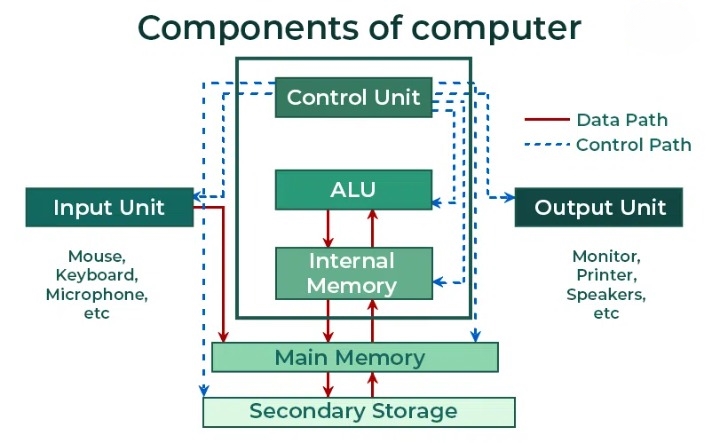
What are the main Components of a Computer?
A computer system consists of several important components:
1. Input Devices
Such devices assist users in keying in data in the computer. Examples Keyboard, mouse, quality scanner, microphone.
2. Central Processing Unit (CPU)
The brain in the computer is the CPU. It interprets instructions, executes calculations and manages all functions.
3. Output Devices
These equipments display the findings of processed data. Examples: Projector, speakers, monitor, printer.
4. Storage Devices
Storages store data and files either on a permanent or temporary basis. Examples Hard disk, pen drive, memory card, CD/DVD.
What are the uses of Computers in Daily Life?
Computers have a wide application in various fields, which include:
-
Online learning, online research education.
-
Documentation, email and data management offices.
-
Account and transaction management banks.
-
Entertainment, game and communication homes.
-
Patient record, diagnosis and report to hospitals.
How do computers play an important role in Education?
The concept of computers has revolutionized the education system. The digital books, videos, presentation, and educational software can be used to impart learning to students. Computers are used by teachers to prepare lessons, assessment and interactive activities. Internet based learning systems have resulted in making education more available and exciting to learners at any time and any learning place.
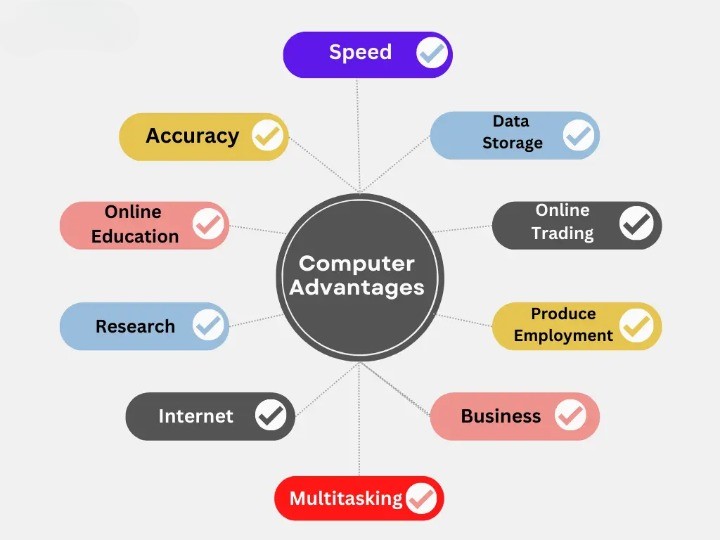
What are the advantages of Computers?
Some major advantages of Computers are:
-
High speed and accuracy
-
Capacity to store massive data
-
Easy access to information
-
Allows email and video conferencing
-
Applicable to learning, research and innovation
Source: chtips
What are the Limitations of Computers?
Despite many advantages, computers also have limitations:
-
Unable to think and make decisions
-
Relie on power and frequent service.
-
At risk of virus and cyber attacks.
-
Excessive use may affect health and eyesight
Fun GK CornerDid you know? |
Conclusion
The perception of the complete structure and functionality of a computer will make the computer be valued by the students who see the purpose of having a computer as more than just in their everyday life. Possessing a computer is not merely a machine; it is an effective instrument serving education, communication, research and innovations. With the ever increasing technology, acquiring knowledge of computers at a very young age can make students very confident and responsible future users of computers.
Computer education at an early age creates curiosity, creativity, and technical skills in young learners.

-1765278168963.jpg "Christmas Countdown 2025: How Many Weeks & Days until Christmas?")


-1766079046715.jpg)

Comments
All Comments (0)
Join the conversation