A compound is a substance that is formed when two or more different chemical elements bond together in a fixed ratio, like water (H₂O) from hydrogen and oxygen or salt (NaCl) from sodium and chlorine. These elements are chemically bonded, not just mixed. These can only be separated by chemical reactions, not physical means.
In everyday life, we refer to these compounds by their commonly known names, but scientifically speaking, these compounds are referred to by chemical names and formulas that are established by the International Union of Pure and Applied Chemistry (IUPAC).
The chemical names and formulas of these compounds represent the types of atoms present and their relative numbers using the element symbols from the periodic table. For example, H₂O represents a molecule of water comprising two hydrogen atoms and one oxygen atom.
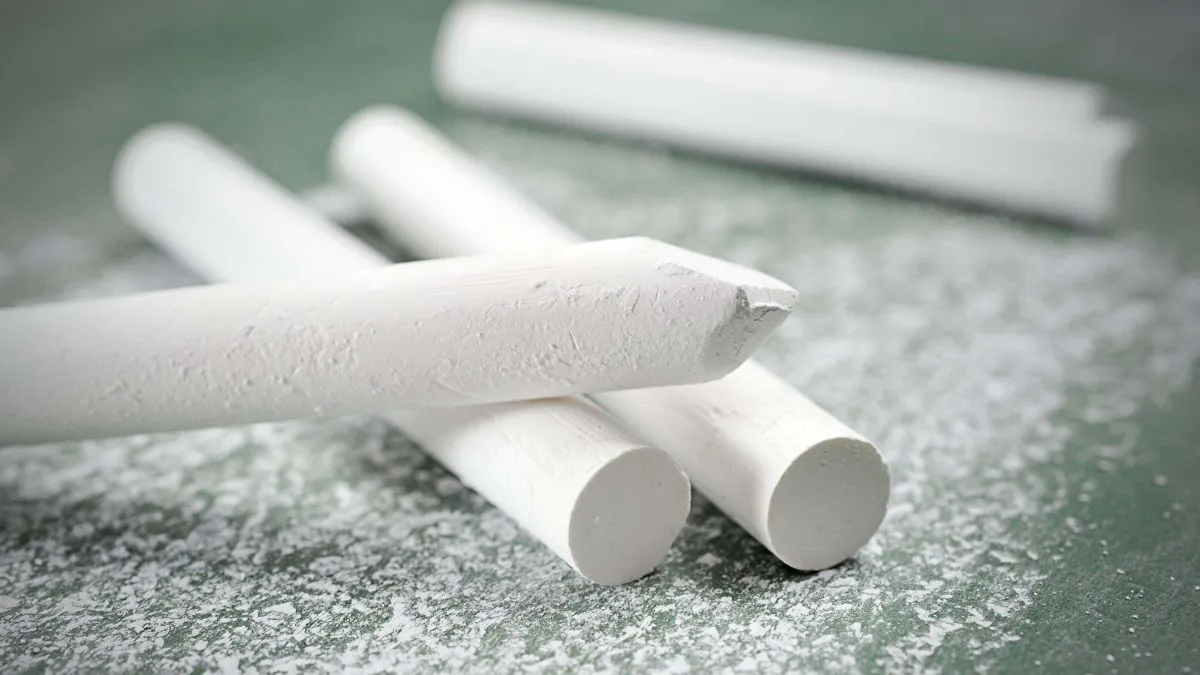
Now, since school time, we have seen teachers using chalk. Today, in this article, we will learn what chalk is and its chemical name, formula, properties, and uses.
What is the chemical name and formula for chalk?

The chemical name for chalk is calcium carbonate.
The chemical formula for chalk is CaCO₃ (one calcium, one carbon, and three oxygen atoms).
Properties of Calcium Carbonate
Chalk is a soft, white sedimentary rock (primarily calcium carbonate) made from the shells and skeletons of marine organisms. Chalk is the mineral form of calcite derived from the remains of tiny sea creatures like plankton.
Physical Properties
Appearance: White to light grey
Texture: Fine-grained, soft
Hardness: Very soft (Mohs hardness around 3.0)
Solubility: Insoluble
Porosity: High (35 to 70 per cent), but with small pores, leading to low permeability
Density: Between 1.8 and 2.7 g/ml.
Opacity: Opaque
Chemical Properties
Composition: Calcium Carbonate
Solubility: Insoluble
Thermal decomposition (Calcination): When heated strongly, chalk breaks down and forms calcium oxide (quicklime)
Uses of Chalk
Chalk is used for writing and drawing (blackboard chalk, sidewalk chalk, and pastels for art) and tailoring (marking fabric for patterns). Chalk is also used for industrial and construction purposes (in paints, paper, plastics, rubber, ceramics, cement, lime, putty, and polishing metals).
Chalk is also used in agriculture and livestock, such as balancing acidic soils to help plants grow. It is also added to livestock feed for calcium. Other uses of chalk also include oil drilling and cosmetics.






Comments
All Comments (0)
Join the conversation