13 Days More for Voyager 1 to Reach One Light-Day From Earth: NASA's Historic Milestone
NASA's Voyager 1 is just 13 days away from reaching one light-day from Earth. Know the expected date, distance, mission details and significance.
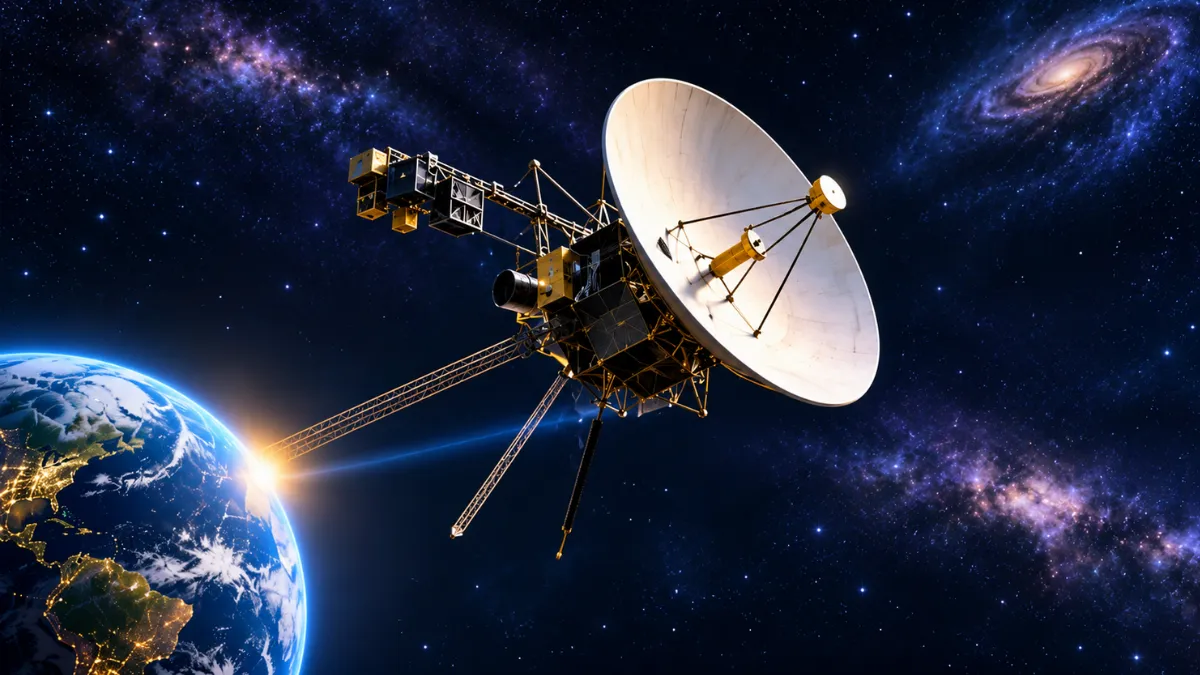
Voyager 1, the farthest human-made object from Earth, is approaching another historic milestone in space exploration. According to NASA, the spacecraft is expected to reach a distance of one light-day from Earth on November 18, 2026. As of November 4, only 13 days remain before this remarkable achievement.
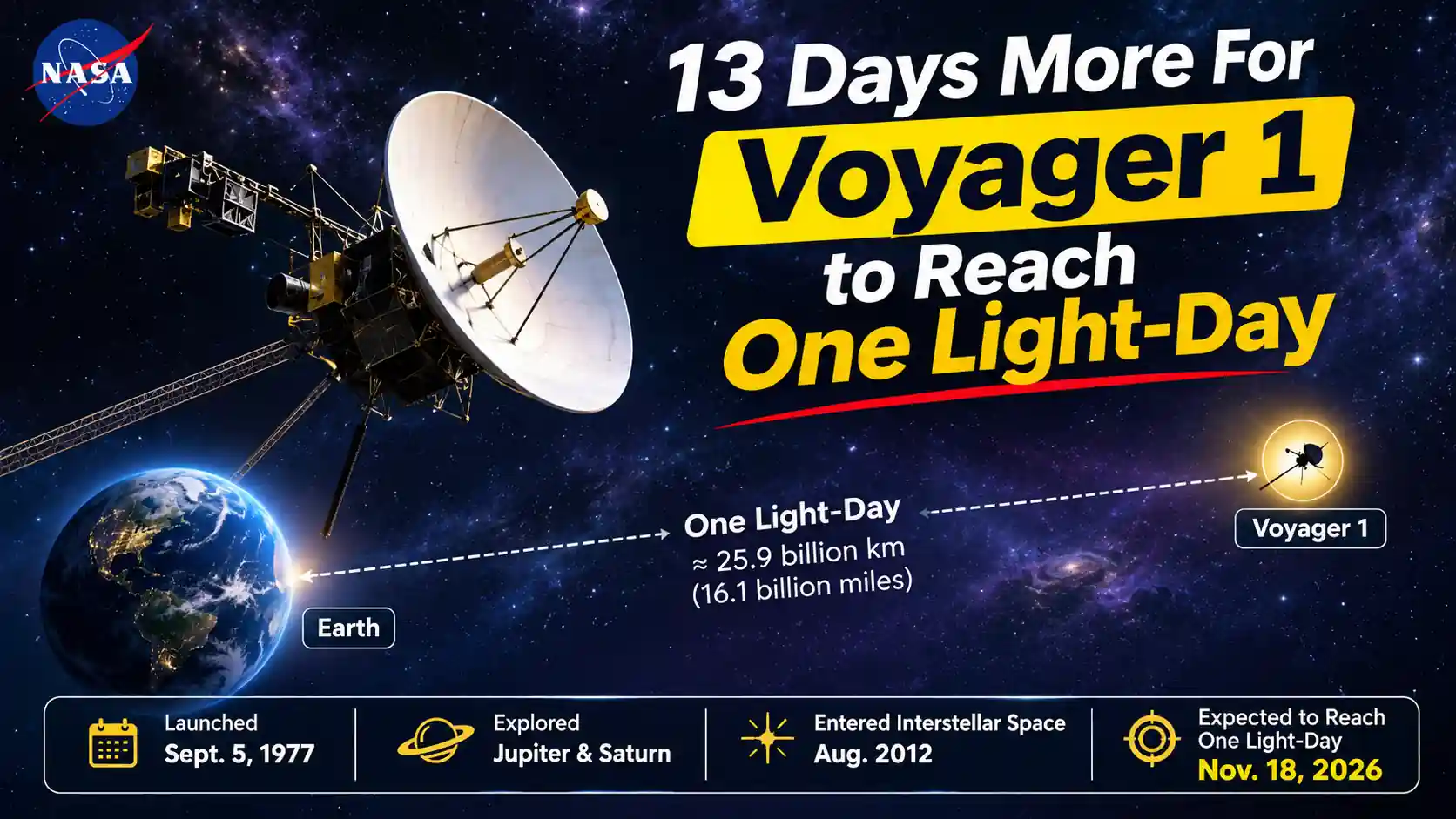
Launched by NASA on September 5, 1977, Voyager 1 has spent more than 49 years travelling through space. It has explored Jupiter and Saturn, entered interstellar space and continued sending scientific information back to Earth.
Reaching one light-day will be a major achievement because it means that a signal travelling at the speed of light will take approximately 24 hours to cover the distance between Earth and the spacecraft in one direction.
But what exactly is Voyager 1, why is this milestone important, and where is the spacecraft heading? Let's find
out.
What Is One Light-Day? How Far Is Voyager 1 Travelling?
A light-day is the distance that light travels in a vacuum in 24 hours. Since light travels at approximately 299,792 kilometres per second, one light-day is equal to approximately 25.9 billion kilometres (16.1 billion miles).
This means that when Voyager 1 reaches one light-day from Earth, a radio signal sent from the spacecraft will take about 24 hours to reach us. Similarly, a command sent from Earth will take approximately 24 hours to reach Voyager 1.
It is important to understand that a light-day measures distance, not time.
What’s Up for November? ☄️ Watch for meteor showers, a close pairing of Mars and Jupiter, and a Voyager 1 milestone. https://t.co/VoQEC55jdC
— NASA JPL (@NASAJPL) November 2, 2026
What Is Voyager 1?
Voyager 1 is an unmanned space probe launched by the United States space agency, NASA, on September 5, 1977. Its original mission was to study the outer planets of our solar system, particularly Jupiter and Saturn.
Although Voyager 1 was launched after its twin spacecraft, Voyager 2, it travelled along a faster route and overtook Voyager 2 on December 15, 1977.
The spacecraft was designed and managed by NASA's Jet Propulsion Laboratory (JPL). It was initially sent to explore the outer solar system but continued its journey beyond the planets.
Some important facts about Voyager 1 include:
-
It is the most distant human-made object from Earth.
-
It became the first human-made object to enter interstellar space.
-
It discovered new moons and rings around Jupiter and Saturn.
-
It carries a Golden Record containing sounds, images and greetings from Earth.
-
It continues to send scientific information to Earth through NASA's Deep Space Network.
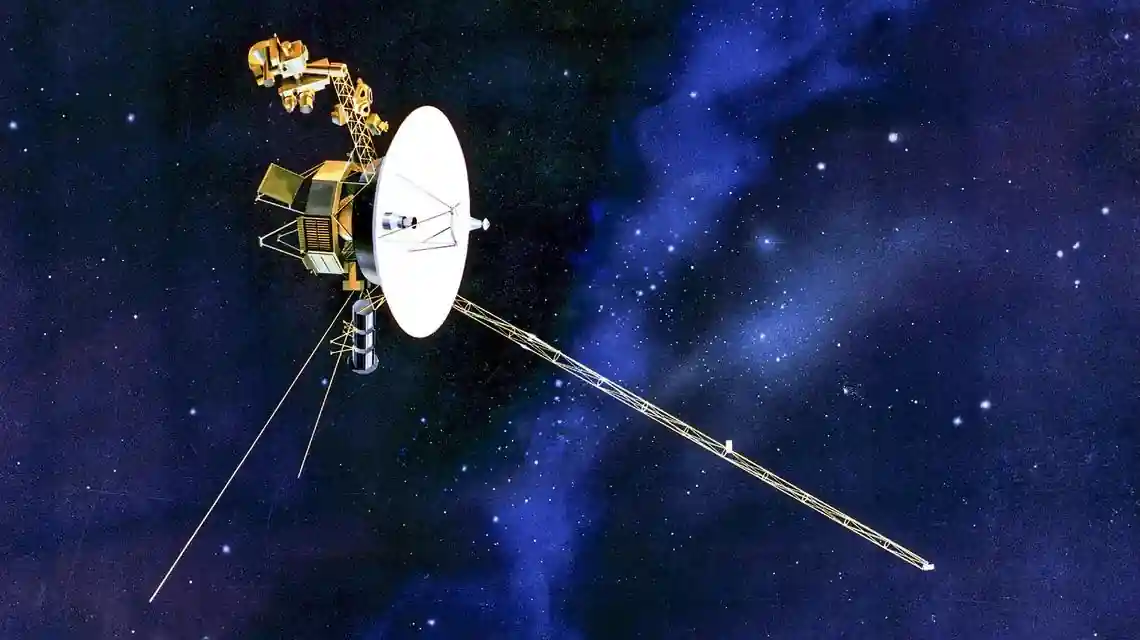
Source: NASA/JPL-Caltech
Voyager 1: Important Facts and Mission Details
Here are some important details about NASA's Voyager 1 spacecraft.
| Aspects | Details |
| Spacecraft | Voyager 1 |
| Country | United States of America |
| Space Agency | NASA |
| Managing Organisation | NASA / Jet Propulsion Laboratory |
| Launch Date | September 5, 1977 |
| Launch Site | Cape Canaveral, Florida, USA |
| Launch Vehicle | Titan IIIE-Centaur |
| Mission Type | Planetary Flyby and Interstellar Exploration |
| Primary Targets | Jupiter and Saturn |
| Spacecraft Mass | 721.9 kg |
| Power Source | Radioisotope Thermoelectric Generators (RTGs) |
| Current Location | Interstellar Space |
| Major Milestone | One Light-Day From Earth |
| Expected Milestone Date | November 18, 2026 |
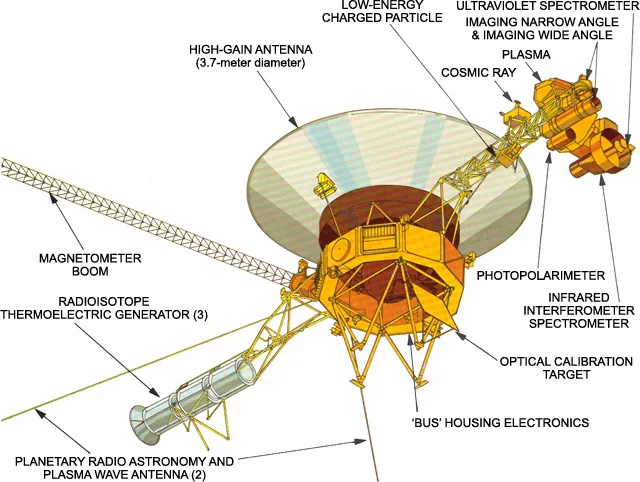
Source: NASA/JPL-Caltech
Why Is Voyager 1's One Light-Day Milestone Important?
Voyager 1's one light-day milestone is important because no other human-made spacecraft has travelled this far from Earth.
On November 18, 2026, the spacecraft is expected to reach approximately 16.094 billion miles (25.902 billion kilometres) from Earth.
At this distance, radio signals travelling at the speed of light will need approximately 24 hours to reach the spacecraft from Earth. The response signal will also take around 24 hours to return.
This means that sending a command and receiving a response could take approximately two days.
However, reaching one light-day will not change the spacecraft's physical condition or its surroundings. It is primarily a historic distance milestone that demonstrates how far human technology has travelled into space.
According to NASA, Voyager 1 is expected to reach this distance on November 18, 2026, at 2:16 a.m. Pacific Standard Time (PST).
What Did Voyager 1 Discover at Jupiter and Saturn?
Voyager 1 made several important discoveries during its journey through the outer solar system. Its observations helped scientists understand the planets, their moons and their surrounding environments.
1. Discoveries at Jupiter
- Voyager 1 made its closest approach to Jupiter on March 5, 1979.
- During its flyby, it discovered a faint ring around Jupiter and two previously unknown moons, Thebe and Metis.
- The spacecraft also captured detailed images of Jupiter's atmosphere and its famous Great Red Spot.
2. Discoveries at Saturn
- Voyager 1 reached Saturn on November 12, 1980.
- During its encounter with Saturn, the spacecraft discovered five new moons and identified a new ring, known as the G-ring.
- It also captured detailed images of Saturn's rings and moons, including Titan, helping scientists learn more about the planet's atmosphere and complex ring system.
These discoveries made Voyager 1 one of the most important spacecraft in the history of planetary exploration.
When Did Voyager 1 Enter Interstellar Space?
Voyager 1 entered interstellar space on August 25, 2012, becoming the first human-made object to cross the heliosphere and enter the region beyond it.
But what is interstellar space?
Interstellar space is the region between stars. It lies beyond the heliosphere, a large protective bubble created by the Sun's solar wind and magnetic field.
The boundary of this bubble is known as the heliopause. Beyond this boundary, the influence of the surrounding interstellar environment becomes stronger than that of the solar wind.
Voyager 1's entry into interstellar space was a historic achievement because it allowed scientists to study an environment beyond the Sun's protective bubble.
Its twin spacecraft, Voyager 2, also entered interstellar space in November 2018.
Where Is Voyager 1 Heading?
Voyager 1 is continuing its journey through interstellar space at approximately 38,000 miles per hour (61,000 kilometres per hour).
It is travelling in the general direction of the constellation Ophiuchus, also known as the Serpent Bearer.
In the distant future, Voyager 1 is expected to pass near a star called AC+79 3888, also known as Gliese 445.
This star is currently more than 17 light-years away from Earth. NASA estimates that Voyager 1 could pass within approximately 1.7 light-years of it in around 40,000 years.
Although the spacecraft is travelling at an extremely high speed by human standards, it is still moving relatively slowly compared with the speed of light.
How Does Voyager 1 Communicate With Earth?
Voyager 1 communicates with Earth through NASA's Deep Space Network (DSN). This network consists of large radio antennas located at three major facilities around the world.
These antennas receive scientific information and engineering data transmitted by the spacecraft.
However, communication has become increasingly challenging because of the enormous distance between Earth and Voyager 1.
NASA's Jet Propulsion Laboratory reported that Voyager 1 briefly lost communication on October 18 and 19, 2026. The signal returned on October 20, and engineers continued communicating with the spacecraft.
NASA engineers have also introduced power-saving measures to extend the mission. In September 2026, they completed an operation called the 'Big Bang', replacing three devices with lower-power alternatives to preserve electricity for the remaining scientific instruments.
What Is the Golden Record on Voyager 1?
One of the most interesting features of Voyager 1 is its Golden Record.
The Golden Record is a 12-inch gold-plated copper disc carried by Voyager 1 and Voyager 2. It was designed to represent Earth and communicate information about human civilisation to any intelligent life that might discover the spacecraft in the future.
The record contains:
-
Greetings in 55 languages.
-
Sounds from Earth, including animal sounds and natural noises.
-
Music from different cultures and periods.
-
Images showing humans, animals, nature and life on Earth.
-
Recorded messages from world leaders.
The Golden Record is like a time capsule from Earth, carrying information about humanity into interstellar space.
Voyager 1 Mission: Important Dates and Timeline
Here is a timeline of some major events in the history of Voyager 1.
| Date | Important Event |
| September 5, 1977 | Voyager 1 launched from Florida, USA |
| December 15, 1977 | Voyager 1 overtook Voyager 2 |
| March 5, 1979 | Closest approach to Jupiter |
| November 12, 1980 | Closest approach to Saturn |
| February 17, 1998 | Became the most distant human-made object, overtaking Pioneer 10 |
| August 25, 2012 | Entered interstellar space |
| October 20, 2026 | Communication restored after a brief signal loss |
| September 2026 | NASA completed the Big Bang power-saving operation |
| November 18, 2026 | Expected to reach one light-day from Earth |
Conclusion
Voyager 1's upcoming one-light-day milestone is a remarkable achievement in the history of space exploration. After travelling for nearly five decades, the spacecraft is preparing to become the first human-made object to reach a distance from Earth that light takes 24 hours to cover.
Even though Voyager 1 was launched in 1977 with a mission to explore Jupiter and Saturn, it continues to help scientists understand the environment beyond our solar system.
Its journey is also a reminder of human curiosity and the progress of space technology. From discovering new moons around distant planets to exploring interstellar space, Voyager 1 has made history and continues to carry a small piece of Earth into the universe.

Prabhat Mishra is a Subject Matter Expert and digital journalist with an extensive background in the competitive exam landscape and over 4 years of experience in education, national and international news, and current affairs. Over his tenure with top knowledge platforms like Mentorship India, IAS BABA, IAS SARTHI, and now Jagran Josh, he has a deep understanding of government exams like UPSC and State PCS, including UP and Bihar, as he has already qualified for the UPPCS 2022 Mains and Bihar 68th Mains. With his core expertise in history, polity, geography & current affairs, he specialises in creating well-researched, aspirant-centric content and simplifying complex topics for competitive examinations.