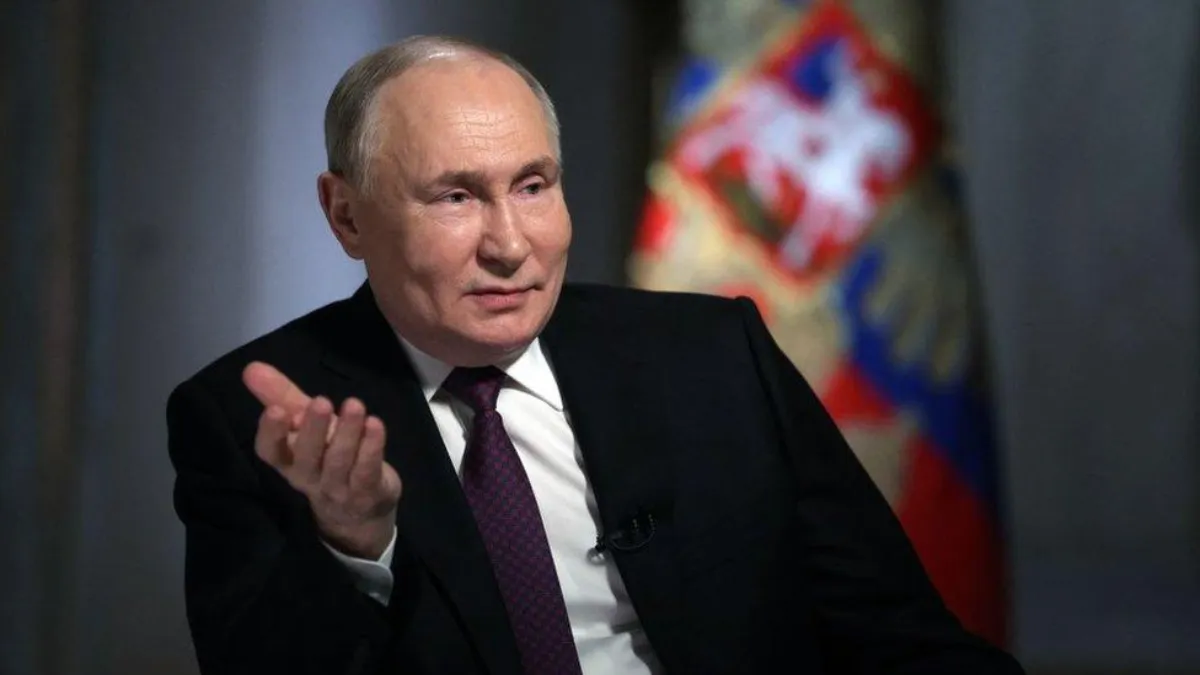
Vladimir Vladimirovich Putin was born on October 7, 1952, in Leningrad, Russia (now Saint Petersburg), and has been the President of Russia since 2012, having previously held the position from 2000 to 2008, interspersed with two terms as Prime Minister. His over two decades of presidency have formed the domestic policies, economy, and international relations of the country. This article provides details about his education and career path, important accomplishments, and other significant facts.
Early Life and Education
Putin was raised in a working-class family as the youngest of three, born to a father who was conscripted into the Soviet Navy and a mother who worked in a factory during the post-WWII hardships in Leningrad. He attended Saint Petersburg High School 281 with the emphasis on German language immersion and spoke German fluently.
In 1970, he entered Leningrad State University, today known as Saint Petersburg State University, and graduated in 1975 with a law degree; his thesis topic addressed international trade principles, and he joined the Communist Party, which at the time was mandatory.
Later, in 1997, Putin obtained a Candidate of Economic Sciences degree at Saint Petersburg Mining University; his thesis was about energy dependencies in foreign policy, supervised by Vladimir Litvinenko. His university mentor, Anatoly Sobchak, influenced his early political interests and later career. Putin also practiced judo and sambo from the age of 12, shaping his disciplined approach.
Intelligence and Early Career
Putin joined the KGB in 1975 following his training at the 401st KGB School and served in counterintelligence, monitoring foreigners in Leningrad. He worked in Dresden, East Germany, between 1985 and 1990, holding the rank of lieutenant colonel, under a cover as a translator, liaising with Stasi, and handling operations when the Eastern Bloc was beginning to collapse. In 1991, he resigned from active duty with the KGB during the Soviet coup attempt, saying that he was against it.
Back in Leningrad, Putin began counseling Mayor Anatoly Sobchak on international affairs from 1990, was leading the Committee for External Relations by 1991, and became First Deputy Mayor in 1994. In 1996, he made his way to Moscow as the deputy head of the Presidential Property Management Department and rose swiftly under Boris Yeltsin.
Rise to Power and Political Career
Appointed FSB director in 1998 and Security Council secretary in 1999, Putin became Prime Minister in August 1999, then acting President after Yeltsin's resignation on December 31, 1999. Elected President in 2000 and reelected in 2004, term limits led him to serve as Prime Minister under Dmitry Medvedev from 2008 to 2012. He reclaimed the presidency in 2012, winning reelection in 2018 and 2024 with 87.3% of votes amid controversy.
His presidency marked centralization in the federal districts he created in 2000 and government reforms to counter regional separatism. Putin guided economic booms from oil revenues, military reforms, and interventions like Chechnya and Georgia.
WHAT'S NEXT| What is the S-500 Missile System? Check Its Features, Cost, Range and Other Key Details
Major Achievements and Policies
The early presidencies witnessed average 7% annual GDP growth from reforms and high oil prices, debt repayment by 2005, and WTO entry in 2012. Putin reasserted federal control over Chechnya, consolidated industries like aviation under United Aircraft Corporation, and advanced energy deals such as Power of Siberia with China.
Military modernization reduced forces to one million, professionalized NCOs, and boosted nuclear capabilities post-U.S. ABM withdrawal. Domestically, he codified land, tax, and procedural laws, hosted global events like the 2014 Sochi Olympics and 2018 FIFA World Cup, and promulgated conservatism in line with the Russian Orthodox Church. Many critics point to authoritarian changes, abysmal corruption and press freedom rankings.
Personal Life and Legacy
He has two daughters, Maria 1985 and Katerina 1986, and keeps his family very private. His judo black belt and outdoors pursuits tend to reinforce a strongman persona. Russia's longest-serving leader since Stalin, Putin's era is marked by muscular foreign policy, including the annexation of Crimea and involvement in Ukraine, coupled with sanctions and ICC warrants. Ongoing policies emphasize economic stability and Arctic claims.

-1764939644739.jpg)
Comments
All Comments (0)
Join the conversation