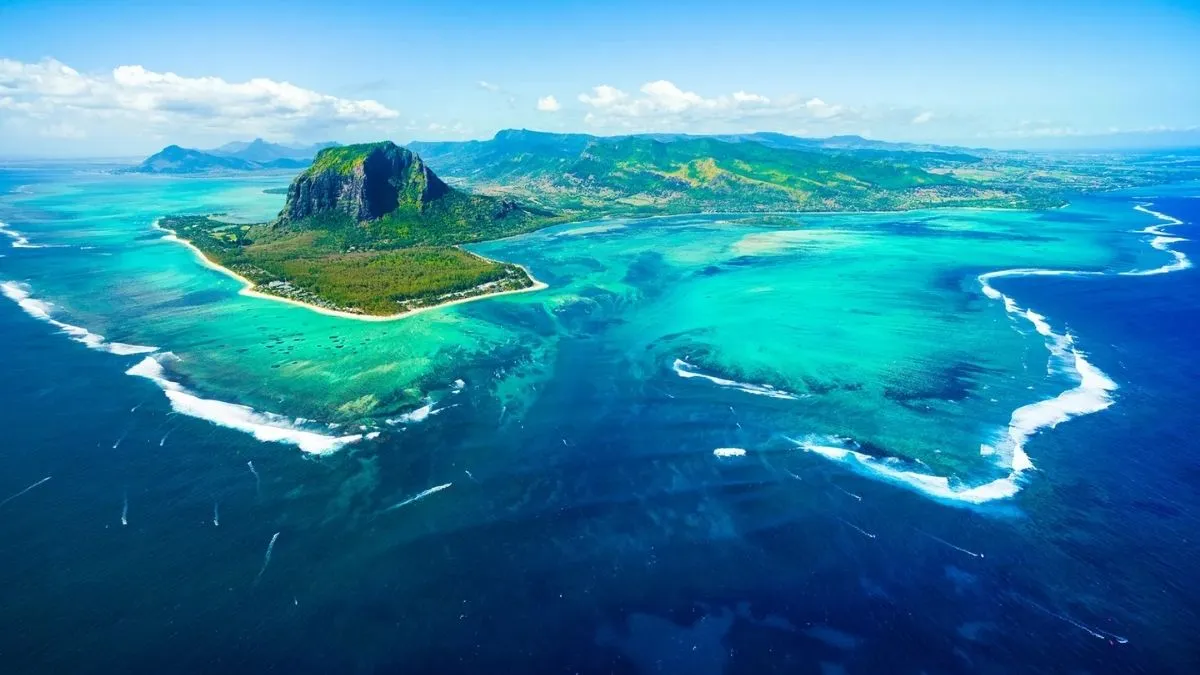
When we think of the world's largest waterfalls, we always think of Angel Falls, which might be the highest and largest waterfall in the world.
But, apparently, this is not true.
Angel Falls is the largest waterfall in the world on land, but if we talk about the Earth, this water is not the largest.
So, the question arises here: where is the world's largest waterfall located?
Let’s explore in detail to know more about the World’s Largest Waterfall.
Where is the World’s Largest Waterfall Located?
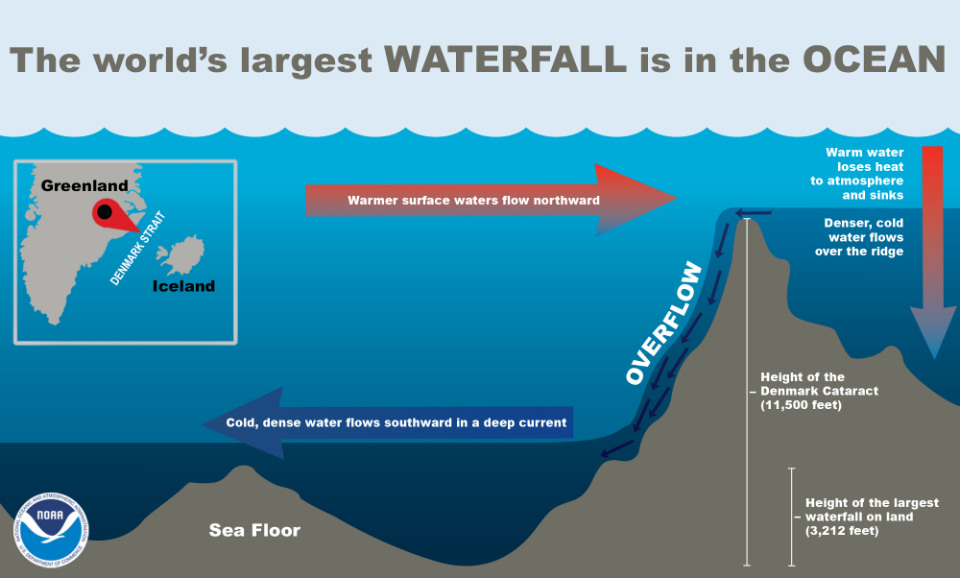
As per the NOAA, the world’s largest waterfall is known as the Denmark Strait cataract.
It lies beneath the Denmark Strait, the stretch of ocean separating Greenland and Iceland.
It exists deep beneath the ocean surface, hidden from human eyes and powered by ocean physics rather than gravity alone.
Also Read: Is Greenland a Country or an Island?
Facts on the location of the Denmark Strait cataract:
-
It is found entirely underwater
-
This waterfall connects the Greenland Sea and the Irminger Sea
-
This waterfall was discovered by oceanographers in 1989 using scientific instruments
How Big is this Underwater Waterfall?
In terms of sheer scale and power, no land-based waterfall comes close.
| Feature | Denmark Strait Cataract | Angel Falls |
| Height | ~3.5 km (2.2 miles) | 979 m |
| Width | ~160 km | Narrow |
| Water flow | ~5 million m³ per second | Far smaller |
| Visibility | Completely underwater | Fully visible |
Source: NOAA
The underwater cataract is over three times taller than Angel Falls and spans a width comparable to a small country.
Source: NOAA
How can the World’s Largest Waterfall Exist Underwater?
The World’s Largest Waterfall Exist Underwater due to a phenomenon of water density, not air exposure.
As per the National Oceanic and Atmospheric Administration, the Denmark Strait cataract Waterfall Exist Underwater because of these reasons, which are:
-
Cold water is denser than warm water
-
Frigid water from the Nordic Seas flows southward
-
When it meets the warmer water of the Irminger Sea, it sinks
-
The dense water plunges over a massive drop in the ocean floor
-
This creates a powerful downward cascade, similar to a waterfall
Although invisible, the turbulence is immense and measurable only with advanced oceanographic tools.
How is climate change becoming a threat to the Underwater Waterfall?
Rising global temperatures are disrupting this delicate process.
Scientists warn that:
-
Due to the warmer oceans, it can reduce cold, dense water formation in a stable underwater waterfall
-
Due to global warming, glaciers are melting, which could lead to a lower water density.
-
Reduced sea-ice formation weakens deep-ocean circulation
Marine researchers, including European oceanographic teams, have observed weakening density-driven flows in other regions—raising concerns for deep-sea ecosystems that rely on this circulation.
In conclusion, it has been seen that the World’s Largest Waterfall isn’t on Land, but rather it is located underwater in the ocean. The Denmark Strait cataract, which is the world’s Largest Waterfall, is one of the greatest natural wonders, and it is not always visible because it is hidden beneath the ocean.
But this underwater waterfall plays a crucial role in climate regulation and ocean circulation, reminding us how much of our planet remains unexplored—and vulnerable to change.





Comments
All Comments (0)
Join the conversation