BRICS vs G7: Key Differences, Economic Power, Membership and Global Influence Explained
G7 vs BRICS in 2026: Explore the key differences between the two major global blocs, including membership, economic strength, population, political influence, objectives, and their role in shaping the future world order.
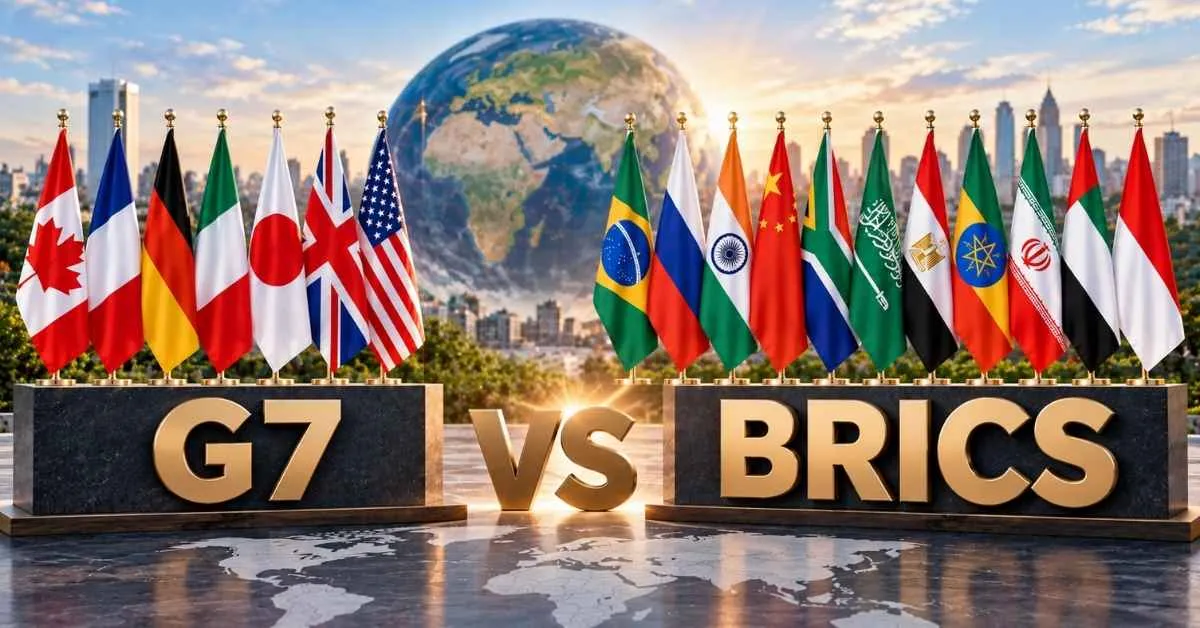
The relationship between the Group of Seven (G7) and BRICS marks one of the most significant changes in global geopolitics and international economics. Historically, the G7 has played the role of the main international steering committee for Western economies whereas the BRICS nations have expanded their influence as the voice of the Global South.
What are G7 countries?
The "Group of Seven," or G7 countries, came into existence informally in the 1970s, subsequent to the oil crisis in 1973 and an unstable currency. The G7 is effectively a forum formed by seven of the most advanced nations in political and economic terms.
One of the objectives of the G7 is to provide consensus regarding economic policies, promote financial stability around the globe and ensure standards of international security.
What are BRICS countries?
The inception of BRICS took place in 2006 (then known as BRIC until South Africa’s accession in 2010) as a non-official group of major countries that aspire to rectify the global governance imbalance.
BRICS can be described as a multilateral organization aimed at diversifying economies and reforming global institutions such as the IMF and the World Bank.
G7 and BRICS Member Countries in 2026
Countries of G7
G7 is a prominentand exclusive group of seven countries, including European Union representatives.
The countries of G7 are as follows:
-
United States
-
Canada
-
United Kingdom
-
Italy
-
France
-
Japan
-
Germany
Member Countries of BRICS
BRICS has become a significantly expanded multilateral bloc. The full member countries of BRICS are:
-
Initial Members: Brazil, Russia, India, China and South Africa
-
Extended Members: Egypt, Ethiopia, Iran, Saudi Arabia, the United Arab Emirates and Indonesia
-
BRICS Partner Countries
-
BRICS also associates several partner countries, which include Malaysia, Thailand, Vietnam, Nigeria, Kazakhstan and Uzbekistan.
| Feature | Group of Seven (G7) | BRICS |
| Full Members | 7 Nations (US, UK, Canada, France, Germany, Italy, Japan) + European Union | 11 Nations (Brazil, Russia, India, China, South Africa, Egypt, Ethiopia, Iran, Saudi Arabia, UAE, Indonesia) |
| Economic Classification | Advanced, high-income industrialized economies | Emerging markets, developing nations and major commodity exporters |
| Share of Global Population | 10% | 45%–48% |
| Nominal GDP Share | 43%–44% of global total | 29%–35% of global total |
| GDP by PPP Share | 30% of global total | 35%–37% of global total (surpasses G7 in Purchasing Power Parity) |
| Financial Institutions | IMF, World Bank, European Investment Bank (EIB) | New Development Bank (NDB), Contingent Reserve Arrangement (CRA) |
| Primary Focus and Agenda | Rule of law, open markets, Western security coordination, liberal political frameworks | Multipolar world order, local currency trade, de-dollarization, Global South representation |
G7 vs BRICS Comparison on Economics
The economic supremacy between the two groups primarily depends on the method of calculating output whether through nominal GDP or purchasing power parity (PPP).
GDP Comparisons: Nominal vs. PPP
Nominal GDP: The G7 still exerts power in nominal GDP, accounting for about 43% to 44% of total world nominal GDP with most of it attributable to the United States. On the other hand. The BRICS group has about 28% to 29% of total world nominal GDP.
GDP at Purchasing Power Parity: If GDP is adjusted according to domestic price levels and costs of living, the situation changes in favor of the BRICS group. Thanks to the industrial output of China and India. The extended BRICS group holds over 40% of global GDP (PPP) compared to about 28% for the G7.
Share of World Trade and Economic Performance
G7: Enjoys leadership in global finance, high-tech research, capital markets, and high-tech goods export. Currencies used in G7 countries, especially the US dollar and euro, is mostly used for international reserves and global payments via the SWIFT service.
BRICS: It dominates the physical basis of global production of goods and natural resources. This BRICS group plays a major role in manufacturing, agricultural production, and local currency cross-border trade through the NDB (New Development Bank) as well as other types of settlement systems.
Population, Resources and Market Size
BRICS: Comprising almost 45% of the human population thanks to populous countries like India and China and high population growth rates in Ethiopia, Egypt and Indonesia.
G7: Contributing about 10% of the world population while undergoing major issues like an aging workforce and lowered fertility rates in Europe, Japan and North America.
Natural Resources and Energy Dominance
BRICS has a significant advantage where natural resources are concerned
Energy Resources: Having been joined by Saudi Arabia, Iran, UAE and Russia, BRICS members produce more than 40% of the world’s crude oil and they also have plenty of gas reserves.
Important Metals and Agriculture: BRICS holds substantial shares of the world’s rare earth metals, lithium, copper, wheat, fertilizers and agricultural products essential for the global transition to clean technologies and food security.
Consumer Markets
Though the G7 enjoys substantial income and purchasing capacity, the BRICS bloc represents the most rapidly growing middle-class market worldwide, generating sustained demand for the consumption of vehicles, technology, medicine and various consumer products.
Political Influence and Global Governance
G7: Traditionally has structural advantages over the global financial organizations that belong to Bretton Woods. Member states of the G7 maintain a voting quota that allows their countries to make important decisions concerning the work of the IMF and the World Bank.
Hence having three permanent representatives in the UN Security Council (United States, France and Great Britain).
BRICS: These countries support structural multilateralism and democratic transformations within global institutions in the international arena.
Influence in Global Policymaking and Diplomatic Reach
Governance Model of the G7: An extremely politically united organization that utilises the instruments of economic sanctions, technical regulations, and unified foreign policy objectives to bring about the implementation of rule-based global standards.
Governance Model of the BRICS: A group that operates through consensus across different political systems (from democracies like India and Brazil to monarchies and republics).
The group emphasizes non-interference, national sovereignty, economic cooperation and creating an alternative for countries preferring strategic independence.

Manisha Waldia is a distinguished content strategist with 5 years of experience crafting premium educational content for UPSC and State PCS, with a focus on deep conceptual analysis across Polity, Geography, History, and Environment. She currently brings this expertise to Jagran Josh, where she covers major national and international events, current affairs, and static general knowledge. Over her career, Manisha's specialized insights have led her to curate high-impact materials and serve as a UPSC Mains answer-evaluator for India’s top institutes—including Drishti IAS, Shubhra Ranjan IAS, Study IQ, GS Score, and PWonlyIAS. She has also worked alongside leading NGOs like Oxfam India and Avani Kumaon.
Contact: manisha.waldia@jagrannewmedia.com