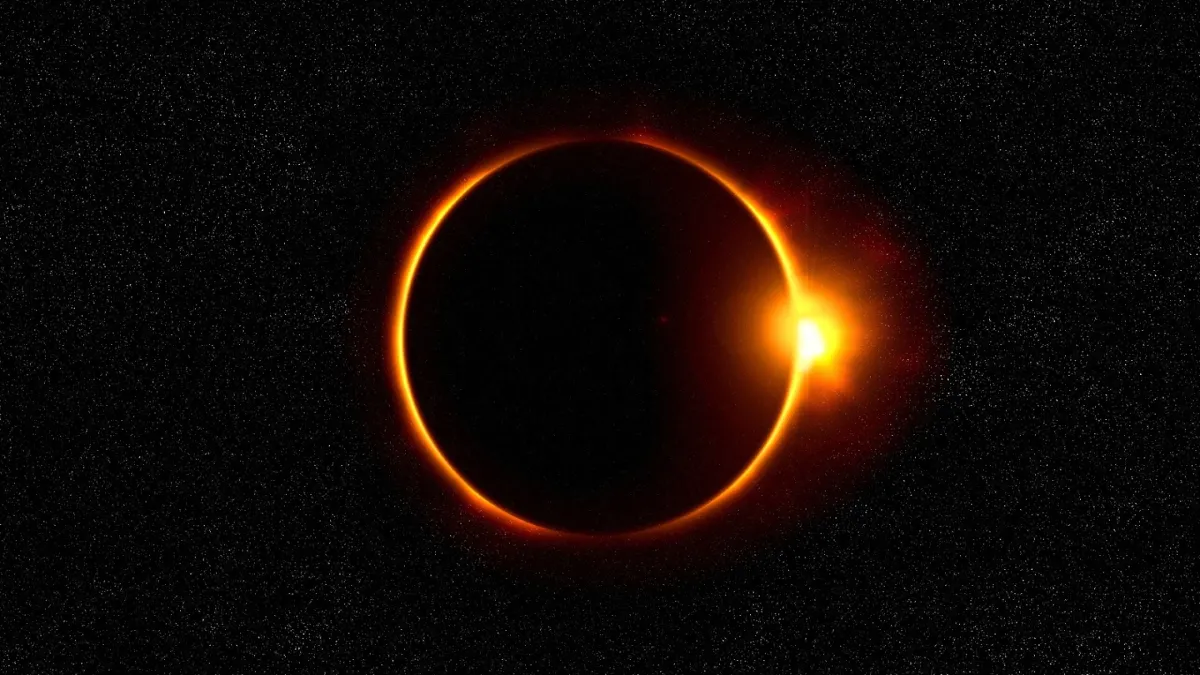
On February 17, 2026, the Moon will cross the center of the Sun, with the particularly famous phenomena called the Ring of Fire appearing, in which the Moon seems too small to cover the Sun completely and leaves a sun ring around it.
This is the best time to observe this celestial event in Antarctica where partial phases will be seen in South Africa, South America and the surrounding oceans, and not in India.
The rarity is emphasized by astronomers because the Moon stands at the apogee phase and hence its size is smaller than that of the Sun.
Annual Solar Eclipse: Event Timeline and Path
Key Phases (Universal Time):
-
Partial Start: 20:57 UTC (southern Pacific).
-
Annularity Beginning: around 22:25 UTC in Antarctica.
-
Maximum Eclipse: ~22:59 UTC; 4-7 minutes duration of the ring in the path of 100-200 km.
-
End of annularity: around 23.34 UTC (South Atlantic).
-
Partially Complete: 00:59 UTC Feb 18 (southern Africa).
Global Visibility Map
| Region | Eclipse Type | Obscuration Peak |
| Antarctica | Annular | 90-98% (4-7 min ring) |
| S. Chile/Argentina | Partial | 40-70% |
| S. Africa | Partial | 20-50% |
| India/Europe | None | 0% |
| Pacific/S. Atlantic | Partial | Up to 80% |
Path crosses vast ocean/Antarctic ice; expeditions (e.g., Space Adventures) booked.
Prime Viewing:
-
Antarctica (e.g., Union glacier): Full ring, clear skies probably.
-
Partial: South Africa, Falklands (30-70% obscuration), Southern Chile/Argentina.
India is out of the area of visibility; NASA/ESA live stream suggested.
What is the Science Behind the Ring of Fire?
Annular eclipses happen close to lunar apogee (approximately 400,000 km away of the Earth), when the Moon subtends 0.96-0.99 solar diameters:
-
Sun is nearly 95% covered; photo sphere edge annulus shining.
-
Brightness 1/100th normal daylight; Beads/chromatic fringes of Baily visible.
In comparison with the complete eclipses, corona is concealed; the sky is getting darker.
ALSO READ| Which River Is Known As The Diamond River Of India?
What is the Solar Eclipse of the Annular Ring of Fire?
An annular solar eclipse also known as the Ring of Fire is a solar eclipse which happens when the Moon is directly above the Earth and Sun yet visible in the sky as a tiny disk, making it seem as though it is directly above the Sun.
This is why it is called the annular, the effect of this corona being of the nature of a ring, annulus in Latin.
This effect occurs particularly when the Moon is close to apogee (its farthest point in its elliptical orbit (approximately 400,000 km)) so that it subtends an angular diameter approximately 0.96-0.99 that of the Sun (both much less than 0.5deg). During alignment:
- The umbra (darkest shadow) of the Moon does not reach the surface of the earth.
- Sunlight is reflected around the lunar edges and illuminates the photosphere in the form of an annulus which is thin and intense.
- Darkness diminishes to some 1/100 th normal daylight; the Beads of the sun (through lunar valleys) at first/last moment briefly glitter.
- In contrast to total eclipses ( Moon at perigee, full coverage ) annular ones have partial illumination and no corona can be seen.
Safe Viewing Guidelines
Do not stare, or permanent retinal damage may be high:
-
Eclipse Glasses: ISO 12312-2 approved (thousands of times darker than shades).
-
Pinhole Projectors: Cardboard + foil safe version foil / aluminum foil safe version.
-
Telescopes: Only Baader solar film, or Herschel wedge.
Live videos: NASA TV, YouTube (e.g., Exploratorium, timeanddate.com)
IN CASE YOU MISSED| Which River Is Known As The Gold River Of India?



-1767073462439.jpg)
-1768241794469.jpg)
-1768222025659.jpg)
Comments
All Comments (0)
Join the conversation