ISC Class 11 History Exam Pattern 2027: Check Paper Structure, Marking Scheme & Syllabus
Know the official ISC Class 11 History Exam Pattern 2027 as per the CISCE guidelines for the 2026-27 academic year. The pattern covers all aspects of the 100 marks assessment process including the format of questions for both theory paper (80 marks) and project work (20 marks), along with syllabus details.
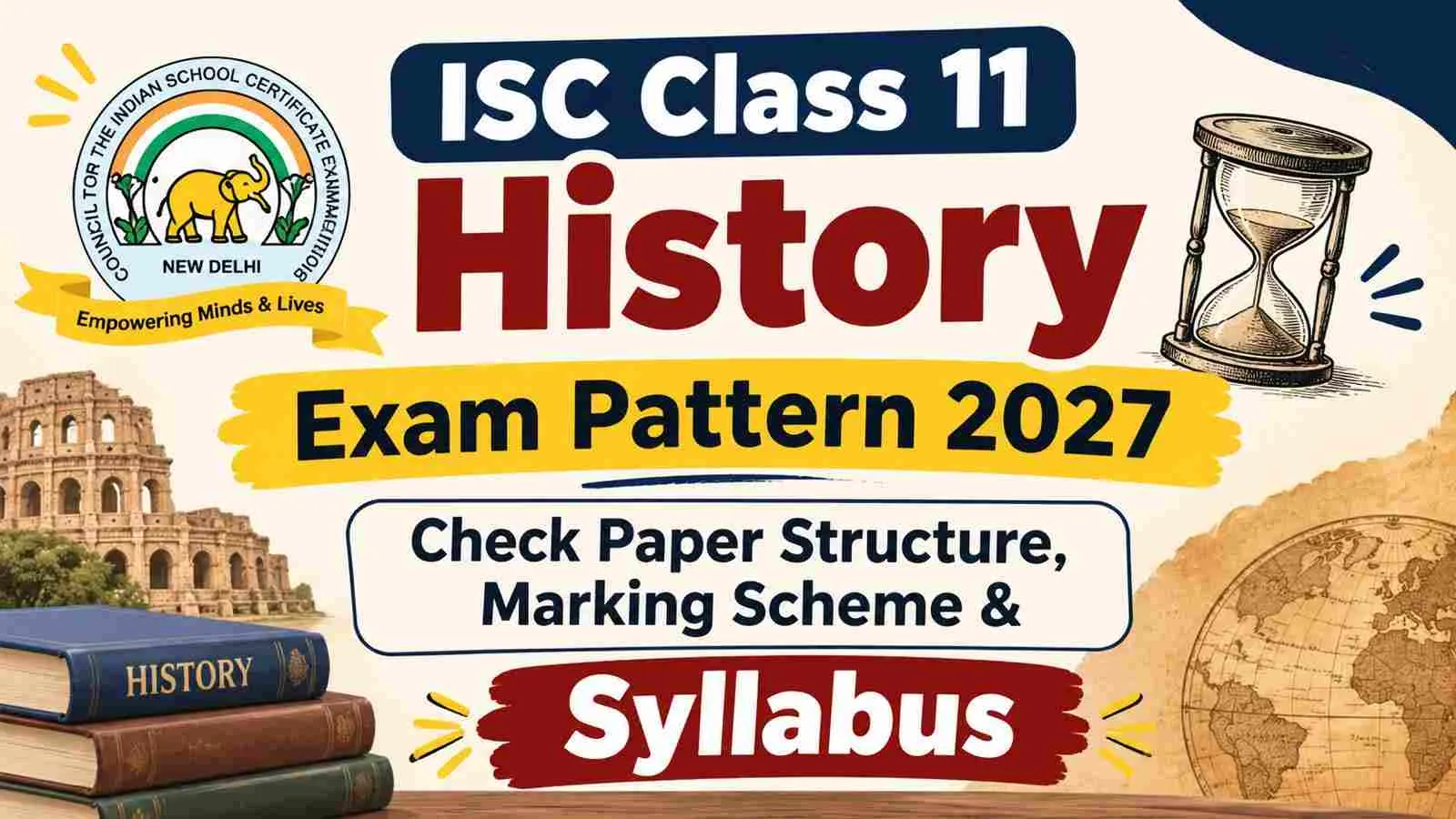
ISC Class 11 History Exam Pattern 2027: The CISCE board holds the ISC Class 11 History test to assess the level of knowledge of key dates, significant events, and sources in history. Getting familiar with the ISC Class 11 History Exam Pattern 2027 at an early stage in the academic year 2026-27 will help students organize their studies efficiently and manage their study time effectively between Indian History and World History before appearing for annual examinations.
The total ISC Class 11 History evaluation carries 100 marks and is divided into two main sections. The first paper consists of the written theory paper carrying 80 marks and has a duration of 3 hours including 15 minutes reading time. In the theory paper, there are short objective questions, analytical short answer questions, and comprehensive long answer essay questions from both Modern Indian History and 20th Century World History. Paper II is Project Work of 20 marks where students have to do a research work on any selected historical topic and give an oral viva voce.
Also Read: ISC Class 12 History Exam Pattern 2027
ISC Class 11 History Exam Pattern 2027: Key Highlights
Below are the key highlights related to the ISC Class 11 History Exam Pattern 2027:
| Particular | Details |
| Conducting Body | Council for the Indian School Certificate Examinations (CISCE) |
| Class & Subject | ISC Class 11 – History (Subject Code: 851) |
| Academic Session | 2026–2027 (For Annual Examination 2027) |
| Total Marks | 100 Marks (Paper I: 80 Marks Theory + Paper II: 20 Marks Project Work) |
| Theory Exam Duration | 3 Hours (plus 15 minutes reading time) |
| Syllabus Divisions | Section A: Indian History (19th & Early 20th Century) Section B: World History (World War I, Interwar Period & Rise of Totalitarianism) |
| Project Work Breakup | Research Process (5 Marks) + Understanding, Application & Analysis (5 Marks) + Presentation (5 Marks) + Viva Voce (5 Marks) |
| Minimum Passing Marks | 35% overall in ISC Class 11 |
| Official Website | cisce.org |
ISC Class 11 History Paper I Structure & Marking Scheme (80 Marks)
In the current CISCE Competency-Based Format, the 3-hour Paper I (Theory), worth 80 marks, consists of three compulsory sections (A, B, and C) on the subjects of Indian and World History:
| Section | Question Type | Question Format & Internal Choice | Marks |
| Section A (Compulsory) | Objective & Very Short Answer Questions | Question 1 consists of 16 sub-parts (1 mark each) including MCQs, fill-in-the-blanks, assertion-reasoning, picture/source identification, and one-line factual recall items covering the entire syllabus. | 16 Marks |
| Section B (Short Answer) | Analytical & Descriptive Short Answers | Consists of 8 questions carrying 4 marks each (word limit: ~80–100 words), with internal choices provided in two questions. Covers both Indian History and World History. | 32 Marks |
| Section C (Long Answer) | Structured Essay / Source-Based Questions | Consists of 4 questions carrying 8 marks each (usually split into sub-parts or structured essays), with internal choices provided in two questions. | 32 Marks |
| Total | Paper I: Written Theory | All Sections Compulsory | 80 Marks |
ISC Class 11 History Exam Pattern 2027: Paper II: Project Work Marking Scheme (20 Marks)
Candidates are expected to present an independent research project that focuses on any topic related to 18th to 20th-century Indian or World History (like case study, fieldwork, local history, oral history, or book/film review).
| Evaluation Criteria | Assessment Focus | Marks |
| 1. Process | Identifying the topic, planning, and structuring the research project. | 5 Marks |
| 2. Understanding, Application & Analysis | Explaining historical issues clearly in context, interpreting evidence, and critical evaluation. | 5 Marks |
| 3. Presentation | Overall format, organization, clear headings, relevant maps/illustrations, and bibliography. | 5 Marks |
| 4. Viva Voce | Oral questioning based on the submitted project work. | 5 Marks |
| Total | Paper II: Internal Assessment / Project Work | 20 Marks |
How to Prepare for ISC Class 11 History Exam 2027?
-
Build Chronologies: Make chronology charts for Indian National Movement (1905-1937) and World History (1914-1939) events to get full marks in Section A.
-
Point Wise Headings for 4 Mark and 8 Mark Questions: Write subjective answers by using headings like Causes, Course/ Features and Impact /Significance and underline the historical terms and acts.
-
Equal Revision Time For Both Sections: Give revision time for both Indian and World history equally because interwar totalitarian states (Stalin, Mussolini and Hitler) have high weight age in Section C.
-
Practice Sources and Pictures Based Questions: Refer cartoons, posters and extracts from textbooks as CISCE uses competency based questions on pictures and sources in Section A.
-
Content Rather Than Decoration In Project Work: CISCE gives marks for historical analysis and proper bibliography in projects, not just decoration.

Siddhi Sharma is an education journalist at Jagran Josh. A Journalism and Mass Communication graduate from IP University, she brings sharp newsroom instincts developed during her previous stint at Zee News. At Jagran Josh, Siddhi specializes in decoding the educational updates. Her coverage is highly exam-centric, ranging from curated news blogs for competitive exams to crucial school board and university news. Combining her strong media foundations with a research-driven approach, she creates reliable, high-utility content that helps students and aspirants stay ahead of the curve. Her writing is factual, engaging, and tailored to meet the fast-paced needs of modern learners and exam aspirants.