-1771656379563.webp)
Show Key Points
CBSE Class 10 English Question Paper 2026 PDFs are available here as the exam was conducted on 21st February 2026 from 10:30 AM to 1:30 PM across examination centres. Students can now download the question paper PDFs for SET 1, SET 2, SET 3, and SET 4 for reference and review.
As per initial reactions, the exam was rated easy to moderate in difficulty. Along with the question papers, detailed analysis and the CBSE Class 10 English Answer Key 2026 PDF are also available here to help students check their responses and estimate their scores accurately.
| CBSE Class 10th English Answer Key 2026 | CBSE Class 10th English Exam Analysis 2026 |
CBSE Class 10 English Question Paper 2026: Key Highlights
CBSE 10th English Exam 2026 was conducted on 21st February, 2026. Students can check the table below for detailed information about CBSE Class 10th English Exam 2026:
| Particulars | Details |
| Conducting Body | Central Board of Secondary Education (CBSE) |
| Exam Name | CBSE Class 10 Board Examination 2026 |
| Academic Session | 2025–26 |
| English Exam Date | 21 February 2026 |
| Exam Timings | 10:30 AM – 1:30 PM (Most Subjects) |
| Exam Mode | Offline (Pen and Paper Mode) |
| Question Paper PDF | Available |
| Official Website |
CBSE Class 10 English Exam 2026 Section-wise Distribution
Check the table below for CBSE Class 10 English Exam 2026 section-wise distribution:
Section | Question Numbers & Details | Marks |
| A. Reading Skills | Q1–2: Two unseen passages—one discursive and one factual/case-based—featuring objective and subjective comprehension questions. | 22 Marks |
| B. Writing Skills | Q3–6: Tests creative output through Application writing (3m), Factual description (4m), Letter to the Editor (7m), and Article writing (8m). | 22 Marks |
| C. Grammar | Q7–9: Assessment of technical accuracy via Cloze (fill in blanks - 3m), Omission (4m), and Sentence Transformation/Reporting (3m). | 10 Marks |
| D. Literature | Q10–12: Includes Extract-based questions (8m), Short Answer questions (10m), and one thematic Long Answer question (8m). | 26 Marks |
| Grand Total | Q1 to Q12 across all sections. | 80 Marks |
CBSE Class 10 English Question Paper 2026 PDF
CBSE Class 10 English Question Paper 2026 SET 1
SECTION – A
READING SKILLS (20 Marks)
1. Read the following text: (10)
(1) Pancakes, a beloved breakfast dish across the world, has a surprisingly long and diverse history. Archaeological evidence shows that people were cooking pancake as food as far back as 30,000 years ago on hot stones and primitive griddles.
(2) In ancient Greece and Rome, pancakes were made from wheat flour, olive oil, honey, and curdled milk. They were often served as a sweet treat during festivals or special occasions. In medieval Europe, pancakes became a popular dish during Shrove Tuesday, the day before Lent began. In France, thin crepes became a national delicacy, often filled with sweet or savoury ingredients. In Russia, blinis were made using buckwheat flour and served with sour cream or caviar. In Ethiopia, the spongy injera became a staple food, made from teff flour and used as both a plate and utensil. Similarly, in China, pancakes are often savoury, while in Japan, fluffy “soufflé pancakes” have become a modern favourite.
(3) The American version of pancakes, thick and soft, gained popularity in the 18th century. The use of baking powder made them light and airy, and they were often served with butter and maple syrup — a symbol of hearty comfort food. Over time, pancakes became a universal dish, symbolizing community and celebration. Whether sweet or savoury, thick or thin, every culture has found a way to adapt this simple food to its own taste and traditions.
(4) India has its own rich tradition of similar dishes that have been enjoyed for centuries. Across the country, almost every region has a version of a pancake — whether sweet or savoury — made from grains, pulses, or rice. These Indian pancakes not only satisfy hunger but also reflect the diversity of India’s culinary culture. In South India, dosas and adai are the most famous forms of pancakes. Made from a fermented batter of rice and lentils, dosas are crisp and light, while adai is thicker and more filling. The fermentation process adds a unique sour flavor and makes them nutritious and easy to digest. In Kerala, the appam, made with fermented rice batter and coconut milk, is soft in the center and crispy at the edges. Moving north, we find the western style cheela, a simple and wholesome Indian pancake made from gram flour, spiced with onions, chillies and coriander. In Maharashtra, the thalipeeth is a multigrain pancake that uses flours like jowar, bajra and rice mixed with spices and vegetables. It is both flavorful and filling, providing a good balance of carbohydrates and proteins.
(5) In the eastern parts of India, pitha is a traditional pancake made during festivals and special occasions. Varieties like patishapta in Bengal are sweet, filled with coconut and jaggery. In Assam and Odisha, pithas can be steamed, fried, or roasted, depending on the custom and region. In the western deserts of Rajasthan and Gujarat, people prepare chilla and handvo, which are savoury western pancake-like dishes baked in traditional ovens. These pancakes are a blank canvas for toppings, waiting for a splash of fruit or a scattering of condiments.
(6) Today, pancakes continue to evolve with new recipes, from vegan and gluten-free varieties to those infused with fruits, oats, or even protein powder. Despite their many forms, they remain a timeless reminder of how food connects mankind through shared history and creativity. Each pancake tells a story of regional identity, food traditions and a deep love for food that brings people together. Pancakes are warm, edible hugs that offer comfort on a bleak day.
Answer the following questions, based on the passage above: (10)
I. In paragraph 1, what does the phrase ‘has a surprisingly long and diverse history’ mean? (1)
II. Complete the following with the correct option from the two given: (1)
The uniqueness of the spongy injera is that ________.
(A) it is both a savoury and a sweet
(B) it can be used for cooking and also for eating
(Paragraph 2)
III. How are American pancakes made light and fluffy? When did the American-style pancakes gain popularity? (Paragraph 3) (2)
CBSE Class 10 English Question Paper 2026 PDF SET 1 (Updated Soon) |
CBSE Class 10 English Question Paper 2026 SET 2
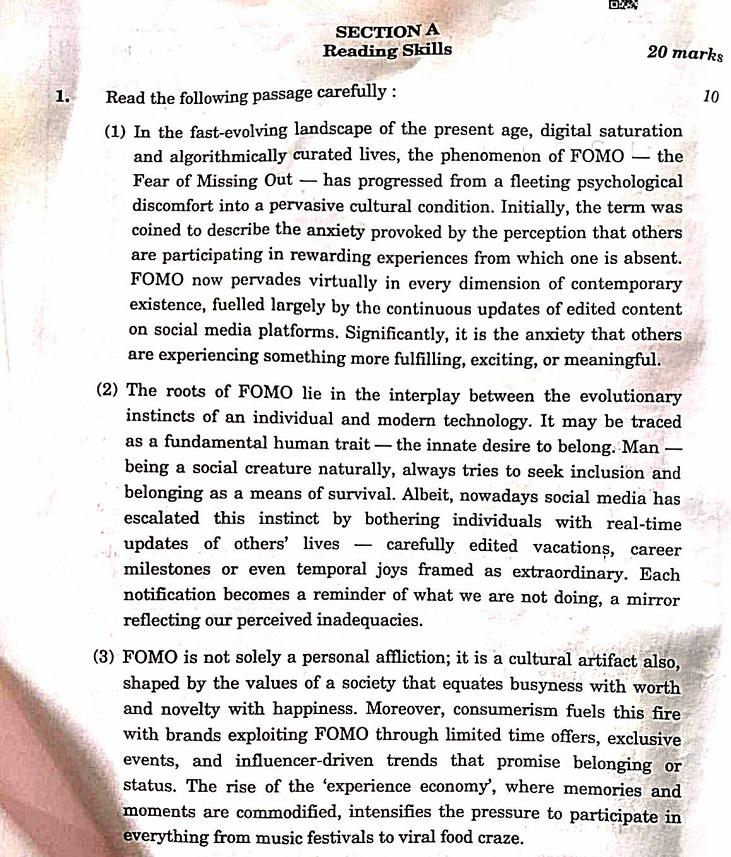
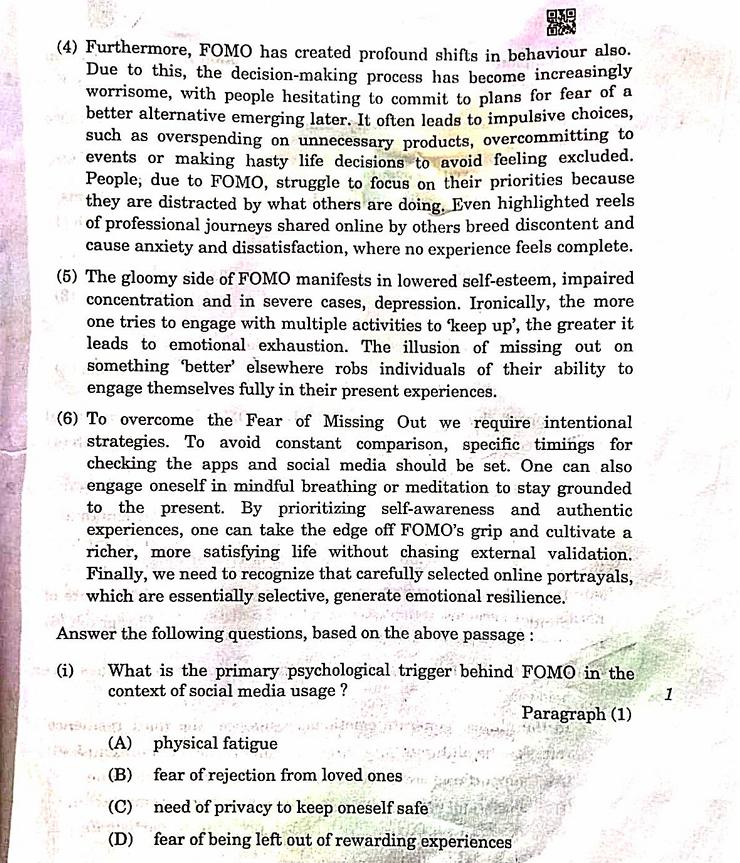
Click on the link given below to download the CBSE Class 10 English Question Paper 2026 for SET 2:
CBSE Class 10 English Question Paper PDF SET 2 |
CBSE Class 10 English Question Paper 2026 SET 3 (2/5/2
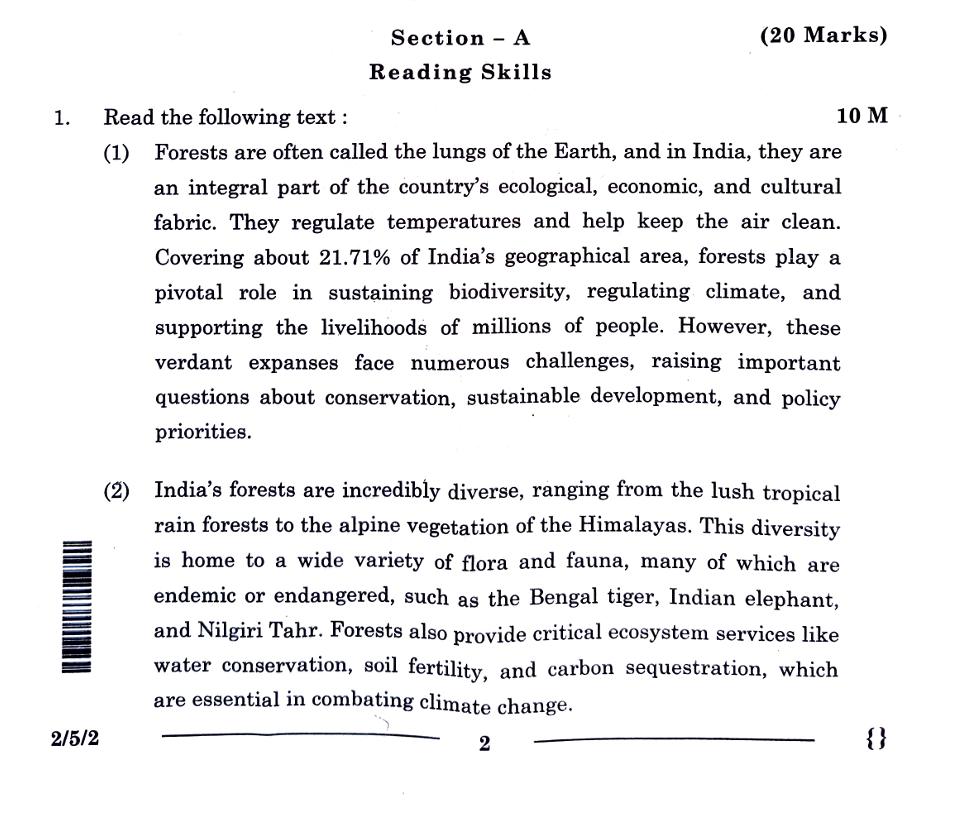
Section – A (20 Marks)
Reading Skills
1. Read the following text: (10 Marks)
(1) Forests are often called the lungs of the Earth, and in India, they are an integral part of the country’s ecological, economic, and cultural fabric. They regulate temperatures and help keep the air clean. Covering about 21.71% of India’s geographical area, forests play a pivotal role in sustaining biodiversity, regulating climate, and supporting the livelihoods of millions of people. However, these verdant expanses face numerous challenges, raising important questions about conservation, sustainable development, and policy priorities.
(2) India’s forests are incredibly diverse, ranging from the lush tropical rain forests to the alpine vegetation of the Himalayas. This diversity is home to a wide variety of flora and fauna, many of which are endemic or endangered, such as the Bengal tiger, Indian elephant, and Nilgiri Tahr. Forests also provide critical ecosystem services like water conservation, soil fertility, and carbon sequestration, which are essential in combating climate change.
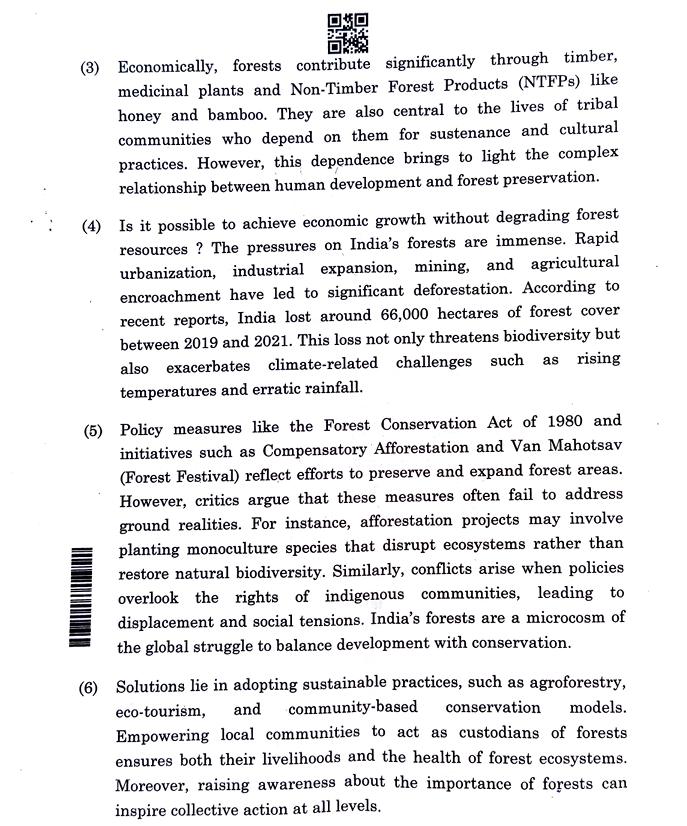
(3) Economically, forests contribute significantly through timber, medicinal plants and Non-Timber Forest Products (NTFPs) like honey and bamboo. They are also central to the lives of tribal communities who depend on them for sustenance and cultural practices. However, this dependence brings to light the complex relationship between human development and forest preservation.
(4) Is it possible to achieve economic growth without degrading forest resources? The pressures on India’s forests are immense. Rapid urbanization, industrial expansion, mining, and agricultural encroachment have led to significant deforestation. According to recent reports, India lost around 66,000 hectares of forest cover between 2019 and 2021. This loss not only threatens biodiversity but also exacerbates climate-related challenges such as rising temperatures and erratic rainfall.
(5) Policy measures like the Forest Conservation Act of 1980 and initiatives such as Compensatory Afforestation and Van Mahotsav (Forest Festival) reflect efforts to preserve and expand forest areas. However, critics argue that these measures often fail to address ground realities. For instance, afforestation projects may involve planting monoculture species that disrupt ecosystems rather than restore natural biodiversity. Similarly, conflicts arise when policies overlook the rights of indigenous communities, leading to displacement and social tensions. India’s forests are a microcosm of the global struggle to balance development with conservation.
(6) Solutions lie in adopting sustainable practices, such as agroforestry, eco-tourism, and community-based conservation models. Empowering local communities to act as custodians of forests ensures both their livelihoods and the health of forest ecosystems. Moreover, raising awareness about the importance of forests can inspire collective action at all levels.
Answer the following questions, based on the passage above:
(i) In paragraph 1, what does the phrase ‘Lungs of the Earth’ refer to with reference to the passage? (1)
(ii) Complete the following with the correct option from the two given:
Forests play a significant role in sustaining biodiversity by ______. (1)
(a) balancing climate change and creating livelihoods for people.
(b) Providing wood for fuel and industries worldwide. (Para 1)
(iii) Support the writer’s idea that forests provide critical ecosystem services with textual evidence. (Para 2) (2)
(iv) What do the recent statistics on deforestation reveal about the state of India’s forests? (1)
(A) Deforestation has decreased significantly.
(B) Forest loss has been stabilized.
(C) Forest cover is rapidly declining.
(D) There is no significant impact on forest cover. (Para 4)
(v) Select the concept that best reflects the complex relationship between human development and preservation. (Para 3) (1)
(a) Rapid urbanization has led to widespread deforestation depriving flora and fauna of its natural habitat.
(b) The introduction of initiatives like Van Mahotsav serve as compensatory afforestation.
(vi) State whether the following statement is true or false: (1)
Deforestation is one of the reasons for erratic rainfall. (Para 4)
(vii) List one challenge that critics see in compensatory afforestation measures. (Para 5) (1)
(viii) How do community-based conservation models benefit both forests and local communities? (Para 6) (2)
2. Read the following passage carefully: (10 Marks)
The Rise of Electric Vehicles in India:
(1) Electric Vehicles (EVs) are gaining significant traction globally. In India, the push for EVs is driven by concerns over air pollution, rising fuel costs and government’s commitment to reducing carbon emissions. The Indian Government has set ambitious targets for EV adoption, aiming for 30% of private cars, 70% of commercial vehicles, and 80% of two wheelers and three-wheelers to be electric by 2030.
(2) The benefits of EVs extend beyond environmental impact: Lower running cost due to cheaper electricity, reduced maintenance because of fewer moving parts, and lower noise pollution in urban areas.
(3) Despite the promising outlook, the EV industry in India faces several challenges currently. While public charging stations are slowly increasing, their availability, especially in semi-urban and rural areas, remains a bottleneck. The initial high purchase cost of EVs and concerns about range or the fear of running out of charge are other causes of anxiety.
(4) To overcome these hurdles, the government is offering subsidies and tax benefits to make EVs more affordable. Private companies are investing in developing new EV models with improved battery technology for longer ranges and battery swapping technology is also being explored as a quick alternative to traditional charging.
(5) The Indian EV market is witnessing rapid growth, with sales figures steadily climbing. In 2023, India recorded sales of over 1.5 million EVs, a significant jump from previous years. Two-wheelers dominated the sales, followed by three-wheelers and then passenger cars. States like Maharashtra, Delhi, and Karnataka have emerged as leaders in EV adoption, largely due to supportive state policies and greater awareness among consumers.
Answer the following questions, based on the above passage:
(i) Electric vehicles offer multiple benefits in India. Support the above statement in 40 words with evidence from the text. (2)
(ii) Select the option that is true for the assertion and reason given below: (1)
Assertion: EVs are gaining traction in India.
Reason: The Indian government is committed to reducing carbon emissions.
(A) Both the assertion and reason are true, and the reason is the correct explanation of the assertion.
(B) Both the assertion and reason are true, but the reason is not the correct explanation of the assertion.
(C) The assertion is true, but the reason is false.
(D) The assertion is false, but the reason is true.
(iii) Justify the following statement: (1)
Despite governmental support, the initial cost of EVs remains a challenge for consumers.
(iv) Complete the following with one suitable reason from the text: (1)
The silent operation of EVs contributes to better urban living because ______.
(v) “In 2023, India recorded sales of over 1.5 million EVs, a significant jump from previous years.”
State any one inference that can be drawn from the above statement. (1)
(vi) According to the passage, what is ‘range anxiety’ in the context of electric vehicles? (1)
(vii) Based on the given text, which type of EV dominated sales in India in 2023? (1)
(viii) Complete the sentence suitably: (1)
To address the challenge of charging infrastructure, various initiatives are being undertaken, such as ______.
(ix) Give one reason to support why the adoption of EVs is slow in some parts of India. (1)
CBSE Class 10 English Question Paper 2026 PDF SET 3 |
CBSE Class 10 English Answer Key 2026
CBSE Class 10 English Answer Key 2026 is now available here after the exam has concluded. Students can use the answer key to check their responses and estimate their expected scores. Detailed solutions have also been provided to support better understanding and self-evaluation. Check the link given below to download the answer key PDF.
CBSE Class 10 Datesheet 2026 for Upcoming Exams
Chck the following table for the CBSE Class 10 Exam 2026 for upcoming exams:
| 23 Feb 2026 | Monday | 10:30 AM–1:30 PM | 003 | Urdu Course–A |
| 24 Feb 2026 | Tuesday | 10:30 AM–1:30 PM | 154 | Elements of Business |
| 25 Feb 2026 | Wednesday | 10:30 AM–1:30 PM | — | Science |
| 26 Feb 2026 | Thursday | 10:30 AM–12:30 PM* | 401 | Retail |
| 27 Feb 2026 | Friday |
| 165 | Computer Applications |
| 28 Feb 2026 | Saturday | 10:30 AM–1:30 PM | 016 | Sanskrit (Communicative) |
| 2 Mar 2026 | Monday | 10:30 AM–1:30 PM | 002, 085 | Hindi Course-A; Hindi Course-B |
| 3 Mar 2026 (Exam Rescheduled for 11 Mar 2026) | - | - | - | - |
| 5 Mar 2026 | Thursday | 10:30 AM–1:30 PM | 008 | Sindhi |
| 6 Mar 2026 | Friday | 10:30 AM–12:30 PM | 049 | Painting |
| 7 Mar 2026 | Saturday | 10:30 AM–1:30 PM | 087 | Social Science |
| 9 Mar 2026 | Monday | 10:30 AM–1:30 PM or 10:30 AM–12:30 PM (Depending on subjects) |
007 | Telugu |
| 10 Mar 2026 | Tuesday | 10:30 AM–1:30 PM | 018 | French |
| 11 Mar 2026 | Wednesday | 10:30 AM–1:30 PM | 017 020 076 088 092 093 094 095 096 097 098 099 254 | Tibetan German National Cadet Corps Bhoti Bodo Tangkhul Japanese Bhutia Spanish Kashmiri Mizo Bahasa Melayu Elements of Book Keeping & Accountancy |





Comments
All Comments (0)
Join the conversation