CBSE Class 10 English Communicative Sample Paper 2027 with Solutions: Download Model Paper PDF FREE
The CBSE Class 10 English Communicative Sample Paper 2027 is a useful resource for students preparing for the upcoming board examination. By solving the model paper and checking the corresponding solutions or marking scheme, students can understand the question format, improve time management and identify areas that require more revision. Students should combine sample-paper practice with thorough syllabus coverage, textbook revision and previous-year question papers for effective preparation.
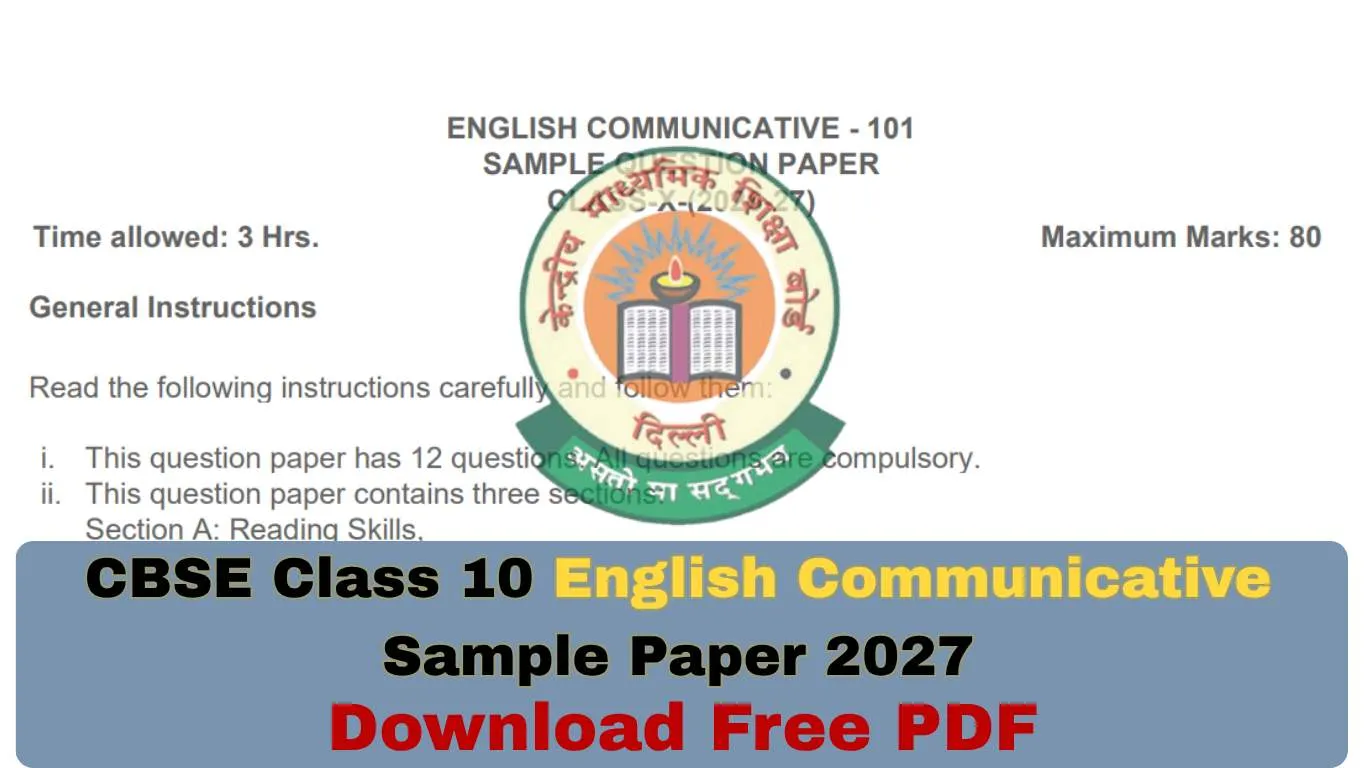
The CBSE Class 10 English Communicative Sample Paper 2027 is an important preparation resource for students appearing for the Class 10 Board Exams 2027. Practising with the sample paper can help students understand the latest question paper pattern, marking scheme, question types and distribution of marks for the English Communicative subject.
Students preparing for the CBSE Class 10 English Communicative exam can use the sample paper to practise reading comprehension, writing and grammar, literature-based questions and other important sections. Solving model papers under timed conditions can also help students improve their speed and identify topics that require additional preparation.
Also Check: CBSE Class 10 English Communicative Syllabus 2026-27
CBSE Class 10 English Communicative Sample Paper 2027: Key Highlights
| Particulars | Details |
| Board | Central Board of Secondary Education |
| Class | 10 |
| Subject | English Communicative |
| Academic session | 2026-27 |
| Examination | CBSE Board Exam 2027 |
| Sample paper | English Communicative |
| Format | |
| Availability | FREE download |
| Official website | cbseacademic.nic.in |
CBSE Class 10 English Communicative Sample Paper 2027 PDF
The CBSE Class 10 English Communicative sample paper 2027 PDF can be used as a practice paper before the board examination. Students should preferably solve the paper without referring to their textbooks or notes and complete it within the prescribed examination time.
General Instructions Read the following instructions carefully and follow them:
i. This question paper has 12 questions. All questions are compulsory.
ii. This question paper contains three sections:
Section A: Reading Skills,
Section B: Writing Skills
Section C: Grammar
Section D: Literature.
iii. Attempt all questions based on specific instructions for each part. Write the correct question number and part thereof in your answer sheet.
iv. Separate instructions are given with each question/part, wherever necessary.
v. Adhere to the prescribed word limit while answering the questions.
SECTION A: READING SKILLS (22 marks) | |||
| 1. Read the following passage carefully: 12 1. What does travel do to you? Do you come back home a different person? Travel could be far more than a change of scenery — it can become a spiritual experience that shakes off our usual certainties and connects us to a richer, vaster world. 2. As celebrated travel writer Pico Iyer reflects, “When you are in a foreign place, you can’t define yourself as you used to.” In unfamiliar surroundings, stripped of familiar routines and expectations, we are no longer the versions of ourselves that we know best. The landmarks that once anchored our identity fall away, and in their absence, a wider self begins to emerge. 3. This transformation is not just poetic — it’s practical. When we travel, we encounter different cultures, traditions, landscapes and belief systems. These interactions gently push us to question our assumptions and recalibrate our worldview. Such places possess a beauty and depth that move almost everyone who visits, regardless of their background or belief. 4. Indeed, many travellers discover that their journey becomes a mirror. The unfamiliar acts as a magnifying glass on the self: our prejudices, fears, joys and curiosities all come into sharper focus. Iyer suggests that in such moments, we return “a different person than the one who left home.” We become more curious, humble and open to the world’s complexity, rather than reinforcing old certainties. 5. Travel’s greatest gift may be humility. When we step out of our comfort zones, we face situations that challenge our assumptions — from language barriers to unfamiliar foods, social norms and customs. This daily negotiation with difference teaches us resilience and empathy. As travellers engage with peoples whose lives have unfolded on very different cultural trajectories, they begin to weave a broader understanding of humanity. 6. But not all travel has to be far-flung to be transformative. Even within one’s own country, journeys through varied landscapes — deserts, mountains, coastlines, forests — can stir a deeper appreciation for life’s diversity and the interconnectedness of all people. In a world where so many people live in digital proximity yet real-world distance, travel reminds us that human experience is far broader than our immediate neighbourhood. 7.Ultimately, travel is not merely about ticking destinations off a list; it’s about letting experiences shape a more expansive sense of self. Whether you walk ancient streets, witness natural wonders, share a meal with strangers, or simply watch a sunset in a place unknown, the journey invites reflection, challenges complacency, and inspires growth. Answer the following questions, based on the passage above. I Why does the writer describe travel as more than “a change of scenery”? a) it provides temporary enjoyment without lasting personal impact b) it provides a brief escape from everyday duties and routines c) it leads to transformation of one’s outlook and self d) it increases awareness of one’s regular habits and surroundings 1 II Complete the following with the correct option from those given in the brackets. In the line ‘a wider self begins to emerge’, the word ‘wider’ indicates ____ (a broader and more inclusive sense of identity / a physically expanded self / an unclear or confused identity). 1 III What does Pico Iyer mean by the phrase ‘you can’t define yourself as you used to’? It means that travel ____ Select the correct option to complete the answer. a) removes all memories of a person’s past life. b) compels individuals to abandon their cultural origins. c) questions fixed identities formed by habit and familiarity. d) eliminates the need for personal identity altogether. 1 IV Give two reasons why encountering unfamiliar cultures can transform a traveller’s worldview. (Answer in 30–40 words.) 2 V Complete the following with the appropriate option. The phrase ‘the journey becomes a mirror’ creates the imagery of a _____. a) reflection revealing one’s inner self b) window opening to the outer world c) shield protecting personal beliefs d) map guiding physical travel VI. What would be the most suitable title for Paragraph 4? a) Pleasure, Escape and Recreation in Travel b) Discomfort, Adjustment and Challenge in Travel c) Humility, Empathy, and Growth Through Travel d) Difference, Distance and Division in a Globalised Travel 1 VII. Fill in the blank by choosing the appropriate option from those given in the brackets. Paragraph 4 includes a _______ (observation / warning / reflection) about how travel challenges assumptions and builds empathy. 1 VIII Which phrase from Paragraph 5 shows that travel does not need to be international to be transformative? 1 IX Why does the writer describe travel as an experience that inspires growth? (Answer in 30–40 words.) 2 X Why does the author suggest that travel helps individuals develop empathy and resilience? 1 | |||
| 2. Read the following. 10 EACH ONE TEACH ONE When Learning is Shared, it Multiplies | |||
| Learning Is Not a Competition. It Is a Responsibility. In every classroom, there are students who quietly struggle. Some hesitate to ask questions. Some need a little more time. Some simply need someone who will sit beside them and say, “Let’s try again.” The ‘Each One Teach One’ project begins with a simple but powerful belief — that learning grows when it is shared. Instead of competing with one another, students become partners in progress. Each volunteer chooses one learner who needs support and commits to teaching them for a few weeks. The focus may be reading, writing, mathematics, grammar, or even exam preparation. When students teach, something remarkable happens. They revise concepts more deeply, understand ideas more clearly, and discover gaps in their own knowledge. Teaching does not reduce what they know; it strengthens it. Education becomes not just a personal achievement, but a shared journey. | Two Learners. One Journey. The impact of this initiative is twofold. The learner gains confidence, clarity, and the courage to ask questions. The student/teacher develops patience, leadership, and empathy. In helping someone else understand, they begin to understand themselves better. More importantly, the culture of the school begins to change. Classrooms become spaces of cooperation rather than comparison. Success is no longer measured only by marks, but by the ability to uplift others. ‘Each One Teach One’ reminds us that education is not merely about scoring well in examinations. It is about building a community where knowledge flows freely and no student feels left behind. One student. One learner. One meaningful difference. | ||
| To volunteer or register for the project, contact the School Social Responsibility Cell or speak to your Class Teacher. Email: eachoneteachone@sspschool.edu Website: www.ssspschool.edu/eachoneteachone Helpline: 98765 43XXX Registrations open till 15 August. | |||
| Answer the following questions, based on your reading of the above information. I. Complete the following with a suitable option. The ‘Each One Teach One’ initiative challenges the idea that learning is primarily a __________. (a) structured institutional obligation (b) competitive individual pursuit (c) government-regulated system (d) performance-based evaluation model 1 II. Complete the following with a suitable option. When the passage states that ‘teaching strengthens what they know,’ it implies that peer instruction leads to __________ understanding. (a) superficial and temporary (b) memorised and mechanical (c) reinforced and conceptually deeper (d) examination-oriented and strategic 1 III. State whether True or False The ‘Each One Teach One’ initiative suggests that academic excellence is best achieved through individual competition rather than collaborative responsibility. 1 IV. Select the option that best explains the phrase, ‘partners in progress’. (a) students working separately to achieve their own academic improvement (b) classmates supporting each other to achieve shared academic growth (c) learners competing actively to secure higher academic positions (d) teachers monitoring students to ensure steady academic progress 1 V. Explain how the initiative benefits the student-teacher beyond academic revision. 2 VI. Complete the following with a suitable option. The phrase ‘no student feels left behind’ suggests ________. 1 (a) automatic promotion of all students regardless of performance levels (b) comprehensive emotional and academic inclusion within the classroom (c) complete abolition of examinations across all grade levels (d) total elimination of differences in student ability and performance VII. Complete the following suitably. By encouraging students to support peers who hesitate to ask questions, the ‘Each One Teach One’ project transforms learning from a competition into a __________. 1 VIII How does the ‘Each One Teach One’ initiative challenge traditional ideas of academic success? Explain with reference to the text. | |||
SECTION B: WRITING SKILLS (22 marks)All the names and addresses used in the questions are fictitious. Resemblance, if any, is purely coincidental. | |||
| 3. You are Riya, Class X-B, Vidyabhavan Public School. Write an application to the Principal requesting permission to set up a Reading Corner in your classroom. State the reason how it will benefit students and suggest one way to manage it effectively. 1x3=3 4. Write a factual description of the School Library in your school in not more than 100 words. Describe its physical layout, seating arrangement and the resources and facilities available for students and teachers. 1x4=4 5. Attempt any one of the two, (A) or (B), in 120 words 1x7=7 A. You are Anish Khanna, a concerned citizen, residing at 45, Green Park, New Delhi. You are deeply worried about the increasing tendency of people to consume antibiotics for minor health issues such as common cold, mild fever, or throat irritation, often without proper medical advice. This indiscriminate intake is leading to serious health problems, including weakened immunity and antibiotic resistance. Write a letter to the Editor of a national daily highlighting the harmful effects of misuse of medication on human health in 120–150 words. Use your own ideas along with those from MCB Unit 1: Health and Medicine, to write this letter. OR B. You recently came across the article that private coaching centres, online tutors and AI-based learning platforms are multiplying. Despite all this, schools continue to play the most crucial role in shaping students’ values, discipline, empathy and social responsibility. Write a letter to the Editor of a national daily as Meera Singh, 102, Rosewood Colony, Jaipur, expressing your views on how schools contribute to value education to create better humans. Use your own ideas along with those from MCB Unit 2: Education, to write this letter. 6. Attempt any one of the two, (A) or (B), in 150 words 1x8=8 A Imagine you are Soham Sharma of Class X. Write an article for your school magazine on the topic ‘Promoting Social Harmony in a Diverse Society’. Emphasise the importance of respect, tolerance and cooperation Explain how social harmony strengthens national integration and suggest practical steps students can take to promote peaceful coexistence in their daily lives. You may use your own ideas along with the given cues and your reading of MCB Unit 6: National Integration.
OR B You are Kritika Kapoor, class X. Write an article for your school magazine on 'The Role of Renewable Energy in Building a Sustainable Future'. In your article, discuss the different types of renewable energy, their benefits to society and the environment and the challenges faced in adopting them. You may include use your own ideas along with the given cues and your reading of the MCB Unit 3: Science
| |||
To get the full sample paper PDF, students can download the link below for FREE.
CBSE Class 10 English Communicative Sample Paper 2026-27: FREE PDF Download |
CBSE Class 10 English Communicative Sample Paper Marking Scheme 2026-27
The students need to know about the marking scheme as well, so that they can write the answers accordingly. Check the marking scheme for CBSE Class 10th English Communicative below:
CBSE Class 10 English Communicative Sample Paper Marking Scheme 2026-27 |
CBSE Class 10 English Communicative Exam Pattern 2027
The sample paper should be studied along with the prescribed syllabus and marking scheme to understand how questions are distributed across different sections. The paper broadly tests students on reading, writing and grammar, and literature. Students should prepare all sections instead of focusing only on literature.
Reading Skills
The reading section tests a student's ability to understand, interpret and analyse passages. Questions may require students to identify information, infer meaning, understand vocabulary and answer questions based on the given text. Regular practice of unseen passages can help students improve both comprehension and time management.
Writing and Grammar
The writing and grammar component tests students on their ability to communicate clearly and accurately. Students should revise the prescribed writing formats and practise grammar questions regularly. While practising, students should pay attention to:
- Correct sentence structure
- Grammar and usage
- Appropriate vocabulary
- Organisation of ideas
- Word limits
- Format and presentation
Literature
The literature section is based on the prescribed CBSE English Communicative texts. Students should focus on themes, characters, important incidents, literary devices and the central ideas of poems and prose. Instead of memorising complete answers, students should understand the text so that they can frame responses according to the wording of the question.
Why Practice CBSE Class 10 English Communicative Sample Paper 2027?
Solving sample papers offers several benefits for board exam preparation.
- Understand the paper pattern: Students become familiar with the type and style of questions that may be asked.
- Improve time management: Completing a full-length paper within the examination time helps students develop an effective strategy.
- Identify weak areas: Checking answers after completing a paper helps students identify topics that need more revision.
- Improve writing skills: Regular practice helps students structure answers more effectively and avoid unnecessary content.
- Build confidence: Solving multiple papers can reduce exam anxiety and make students more comfortable with the question-paper format.
CBSE Class 10 English Communicative Preparation Tips
Students preparing for the English Communicative board examination should combine sample-paper practice with textbook revision.
- Complete the prescribed syllabus before attempting multiple full-length papers.
- Solve at least one sample paper under actual examination conditions.
- Revise grammar rules regularly.
- Practise writing answers within the prescribed word limit.
- Read literature chapters carefully and make short revision notes.
- Analyse mistakes after every practice paper.
- Practise unseen passages to improve reading speed.
- Refer to the official CBSE marking scheme to understand how answers are evaluated.
- Do not rely entirely on memorised answers.
- Keep the final weeks for revision and full-length paper practice.
CBSE Class 10 English Communicative Sample Paper 2027: Sample Paper vs Previous Year Paper
Students should use both sample papers and previous years question papers during preparation. Sample papers help students understand the latest examination pattern, while previous years papers provide an idea of the types of questions asked in earlier examinations.
A combination of both resources can help students identify frequently tested concepts and improve their exam strategy.
Also Check:
|
|
|
|
|
|
|
|
| CBSE Class 10 Sample Paper: Science |

Apeksha Agarwal is an Education Journalist with over 3.5 years of experience. She covers a wide range of topics, including school board examinations, entrance tests, admissions, results, scholarships, and higher education updates. Over the years, she has closely tracked major examinations such as JEE Main, NEET UG, CUET, and various state-level entrance exams, helping students stay informed throughout their academic journey. Apeksha has a Master's degree in Journalism and Mass Communication and a certificate in Digital Journalism. She is passionate about transforming complex educational developments into clear, accessible, and useful information. Her reporting focuses on providing students, parents, and educators with accurate updates and practical insights on examinations, results, and policy changes. She believes that quality education journalism can make a meaningful difference by helping students make informed decisions about their future.