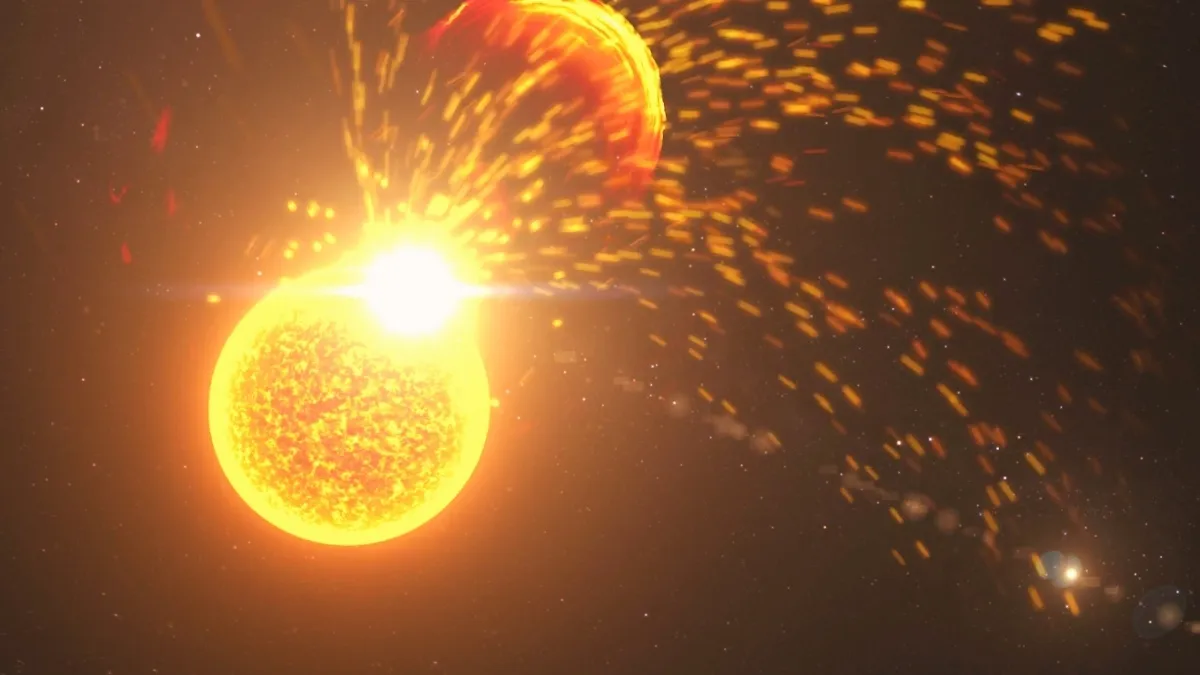
NASA heliophysicists started around-the-clock solar monitoring on March 15, 2026, at the Goddard Space Flight Center in Maryland to protect the four astronauts on the Artemis II mission—Reid Wiseman, Victor Glover, Christina Koch, and Jeremy Hansen—from solar storms on their 10-day lunar flyby mission beginning in April 2026.
Outside the Earth's magnetosphere, solar flares and coronal mass ejections release a million times more radiation than a billion hydrogen bombs exploding at once, causing cancer or illness.
They use the Solar Dynamics Observatory, NOAA's GOES, and the Perseverance Rover on the other side of the planet from Mars to trigger Orion alarms to stack equipment as shields.
The NASA Artemis II was delayed and rolled back to Kennedy Space Center's Vehicle Assembly Building on February 24, 2026.
Solar Storm Risks Prompt NASA to Watch the Sun Ahead of Artemis II
NASA and NOAA monitor eruptions by tracking six Orion sensors and astronauts' personal dosimeters, which sound alarms if radiation increases beyond safe levels.
The NASA Artemis II astronauts also practice moving the water tanks, equipment, and sleeping quarters for mass shielding, as radiation slows down in matter, and liquid water is the best protector, as predicted by radiation models.
The Sun's unstable peak until mid-2026 increases risks for the Artemis II, which is the first crewed Orion flight since Apollo 17 in 1972.
Solar wind speed, magnetic intensity, and particle count from multiple monitoring stations are included in real-time forecast models for eruptions, and there are emergency plans in case of superflares during translunar injection.
NASA Artemis II Deep Space Radiation Dangers
Solar flares accelerate protons at nearly light speed, which is the equivalent of 100 whole-body CT scans in a matter of minutes or fatal in extreme superflares predicted by computer models.
The Earth's magnetosphere shields us from 99% of galactic cosmic rays and solar energetic particles, and the astronauts are exposed completely for 10-day missions due to the lunar vacuum.
Prolonged exposure increases cancer risk by 3-5% per year in deep space, as predicted by NASA's Space Radiation Element.
Acute illness occurs within hours of a major event. Astrophysicist Carlota Velasco Herrera has called for a 2026 launch delay due to the intensity of Solar Cycle 25, but NASA has chosen real-time mitigation over delay.
Monitoring Tech and NASA Artemis II Mission Prep
Perseverance’s Mastcam-Z observes sunspot rotation two weeks in advance from Mars orbit, and the Interstellar Probe observes regions where particles are accelerated.
NOAA’s GOES-R series detects X-ray flare activity in seconds, and the Solar Dynamics Observatory observes the corona in ultraviolet light.
Mission control teams at Johnson Space Center receive and relay the data 30 minutes prior to burn, making the go/no-go call.
Orion’s 5-psi storm shelter provides protection from small doses, and the crew wears active dosimeters in sync with the suits.
Raytheon shielding composites, tested against the 2005 solar event analog, validate the Artemis II mission, a precursor to Mars missions requiring years-long protection.
Check: NASA Artemis 2 Moon Rocket Returns to Pad 39B
NASA’s vigilant watchfulness over the sun makes the Artemis II mission’s return a safe one, a pioneer in deep space safety.



Comments
All Comments (0)
Join the conversation