Show Key Points
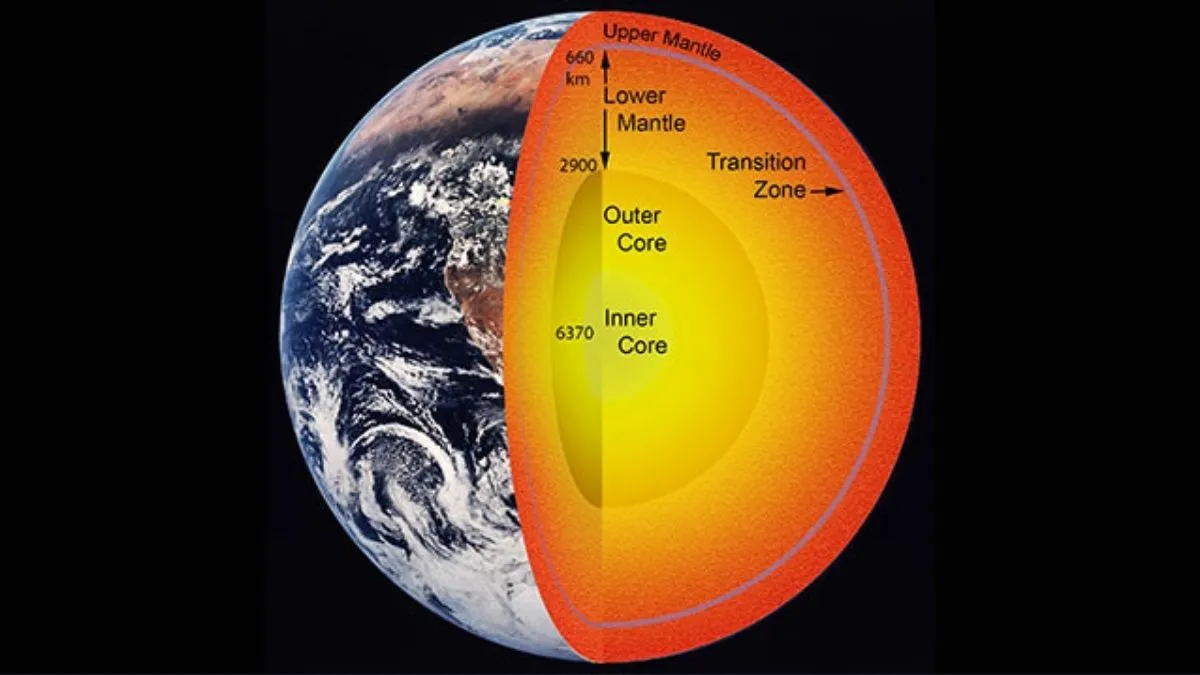
Scientists have found a huge hidden ocean about 400 miles below the Earth's crust. This discovery goes against everything that textbooks say about the geography of our planet. People often call this huge reservoir the 6th ocean, but it's not a liquid sea in the usual sense. Instead, it's chemically trapped in a rare mineral called ringwoodite that looks like a sponge.
According to Northwestern University geophysicist Steven Jacobsen, this internal water supply is so big that it could hold three times the amount of water in all the oceans on the surface. This new information, backed up by data from more than 2,000 seismographs across the United States, suggests that the water on Earth may have come from inside the planet instead of from icy comet impacts.
What is the 6th Ocean Hidden 400 Miles Down?
The term 6th ocean refers to a colossal wet zone located in the Earth's mantle transition zone. Unlike the Atlantic, Pacific, or any other oceans in the world, this water is invisible to the naked eye. It exists in a fourth state, neither liquid, ice, nor vapor, but as hydroxide ions trapped inside the molecular structure of rocks.
-
Location: 410 to 660 kilometers (roughly 400 miles) below the surface.
-
The Mineral: Ringwoodite, a high-pressure sapphire-blue mineral.
-
Volume: Estimated to be 3x the size of all surface oceans.
Is the Hidden Ocean Evidence of an Internal Water Cycle?
For decades, the scientific community debated whether Earth's water arrived via external asteroids. However, the presence of this hidden ocean provides tangible evidence that the Earth’s water cycle is a whole-planet process. This deep-seated reservoir acts as a buffer, preventing the surface oceans from overflowing or disappearing.
| Feature | Surface Oceans | Hidden 6th Ocean |
| State of Matter | Liquid | Molecular (within Ringwoodite) |
| Depth | 0 - 11 km | 400 - 700 km |
| Primary Discovery Method | Visual/Satellite | Seismic Wave Analysis |
| Total Volume | ~1.3 Billion km3 | Estimated ~4 Billion km3 |
Also Read - Venus and Saturn to Pair Tonight: How to See the Rare Planetary Conjunction 2026
How did Scientists Detect the Hidden Ocean?
Scientists used the Earth itself as a huge X-ray machine because people can't drill 400 miles into it. The team looked at seismic waves from more than 500 earthquakes and saw that the speed of the waves slowed down a lot as they went through the mantle's transition zone.
-
Seismic Sluggishness: Waves move more slowly through soggy or hydrated rock than through dry rock.
-
Laboratory Synthesis: Jacobsen’s team recreated the extreme heat and pressure of the mantle in a lab, proving that ringwoodite can soak up water like a sponge.
-
The Diamond Link: A rare diamond found in Brazil, which originated from the deep mantle, was found to contain a tiny speck of ringwoodite, the first direct physical proof of water-rich material at that depth.
Check Out - Obama Presidential Center Set for Historic Grand Opening This June: See Official Dates and Events
This discovery of a hidden ocean 400 miles down fundamentally changes our understanding of Earth’s habitability. If this 6th ocean were to ever leak to the surface, the planet would be almost entirely submerged, with only mountain peaks visible. It remains a silent, deep-earth regulator keeping our world blue and life-sustaining.



Comments
All Comments (0)
Join the conversation