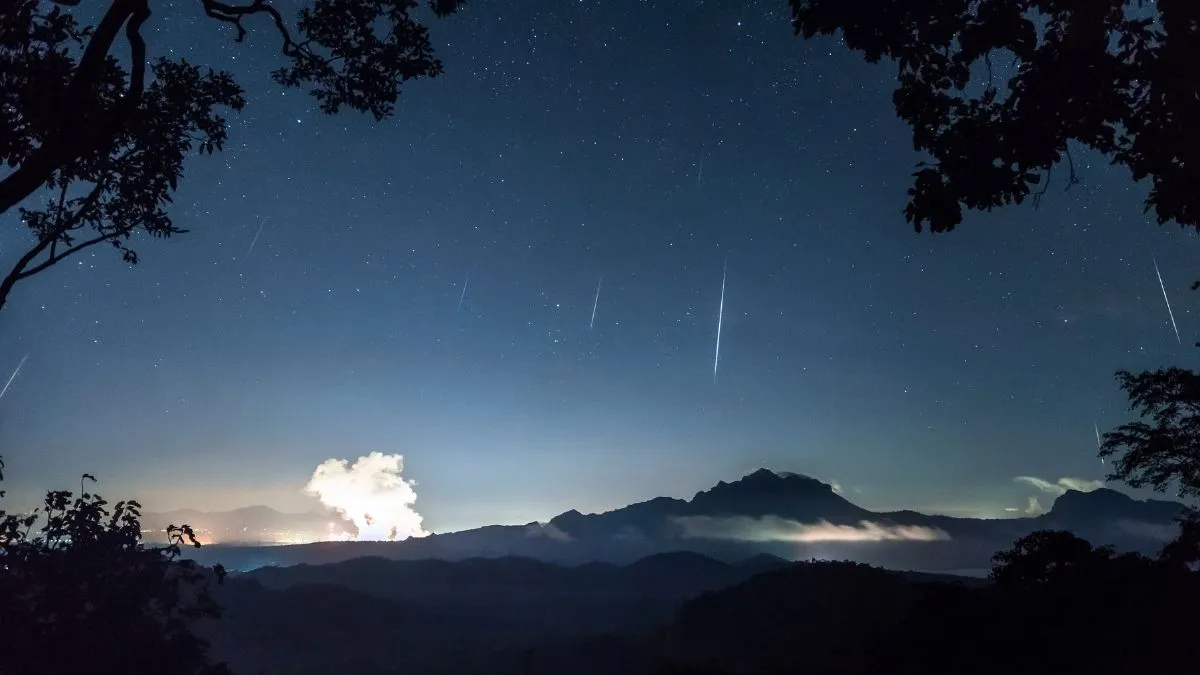
The Geminids meteor shower 2025 is peaking right now, transforming the December sky into a celestial firing range. As of Saturday, December 13, NASA’s Meteoroid Environment Office reports that Earth is entering the densest debris path of asteroid 3200 Phaethon.
Unlike typical showers, the Geminids are rock-star meteors, denser and brighter than comet dust, resulting in vivid yellow and green streaks that are visible even from suburban backyards. With the moon remaining a slim, 30% waning crescent that won't rise until 2:00 AM, tonight offers a rare, four-hour window of pure obsidian skies.
However, for millions of Americans, the biggest challenge isn't the moon; it’s a developing storm system over the Atlantic Seaboard that could obscure the best meteor shower of the year.
What is the Geminids Meteor Shower 2025 Weather Forecast?
The weather is the deciding factor for tonight's display. According to the latest National Weather Service (NWS) maps, a high-pressure system is favoring the Midwest and West, while the East Coast faces a literal "washout."
| US Region | Sky Conditions | Stargazing Outlook |
| Midwest & Great Plains | Crystal Clear / Frigid | Excellent: Fargo and Chicago will see sub-zero temps but perfect clarity. |
| South & Southwest | Mostly Clear | Excellent: Texas to Arizona will have the most comfortable viewing temps (50°F+). |
| West Coast | Clear to Scattered | Good: High visibility for California and the Rockies. |
| Northeast & Mid-Atlantic | Overcast / Rain | Poor: A cold front along the Seaboard is bringing 80–100% cloud cover. |
The radiant point, or the part of the sky where the meteors seem to come from, is in the Gemini constellation. More meteors can be seen as Gemini rises higher in the night sky. The peak time is around 2 a.m., when the constellation is at its highest.
The night skies have some special gifts for you this December:
— NASA (@NASA) December 1, 2025
- The peak of the Geminid meteor shower
- The closest approach of 3I/ATLAS to Earth (at about 170 million miles)
- A Jupiter-Moon conjunction
Get more details on this month’s celestial sights: https://t.co/wmmYGYDqgb pic.twitter.com/hpm5fyOmTc
When to Watch Geminids Peak Tonight?
The Geminids are unique because the radiant rises early. You don't have to wait until 3:00 AM to see activity, making this the perfect event for families.
-
9:00 PM to 11:00 PM: Activity begins. Look East. You may catch Earth-grazers, long, slow meteors that skim the top of the atmosphere.
-
12:00 AM to 2:00 AM (The Prime Window): This is the Golden Hour. The Moon has not yet risen, and the radiant is nearly overhead. Expect 120-150 meteors per hour in dark-sky areas.
-
2:00 AM to Dawn: The waning crescent moon rises. While it will wash out the faintest streaks, the Geminids produce enough bright "fireballs" to remain visible until the sun comes up.
Why is 3200 Phaethon acting like a Rock Comet?
Most shooting stars come from icy comets. The Geminids come from an asteroid. NASA scientists are currently monitoring 3200 Phaethon as it nears the sun, observing how it sheds rocky debris instead of ice. This makes Geminid meteors move at a "medium-slow" speed of 22 miles per second, allowing the human eye to track them more easily than the lightning-fast Leonids.
How to Watch Geminids Peak Tonight without a Telescope?
To catch the dazzling spectacle of the Geminid meteor shower, you do not need binoculars or a telescope. In fact, specialized equipment will only limit your field of view. Follow these tips endorsed by official skywatching organizations:
-
The single most important factor is finding a safe location far away from the city and street lights. This is vital to seeing the fainter meteors.
-
Give your eyes at least 30 minutes in the darkness to fully adjust to night vision. Avoid looking at white light sources, including phone screens, during this time.
-
Mid-December nights are freezing. Bundle up with layers, blankets, and a thermos of a warm beverage. Use a reclining lawn chair or lie flat on a mat to avoid neck strain.
-
Meteors can appear in any part of the sky, but the shower appears to radiate from the Gemini constellation, which rises in the east in the early evening. Look slightly away from the radiant to capture the longest, brightest streaks.
-
Meteor activity often comes in bursts. Plan to spend at least an hour outside to significantly increase your chances of seeing the most spectacular fireballs.
Check Out: Meteor Showers List 2025: When & How to See the Shooting Stars Tonight in the US
The Geminids meteor shower 2025 offers a rare blend of exceptional rates and perfect dark-sky conditions, setting the stage for a spectacular show as the year winds down. Astronomers urge Americans to take advantage of this optimal peak window before the Moon brightens, providing a memorable, entirely natural celestial fireworks display.




-1765534222411.jpg)
-1765619854720.png)
Comments
All Comments (0)
Join the conversation