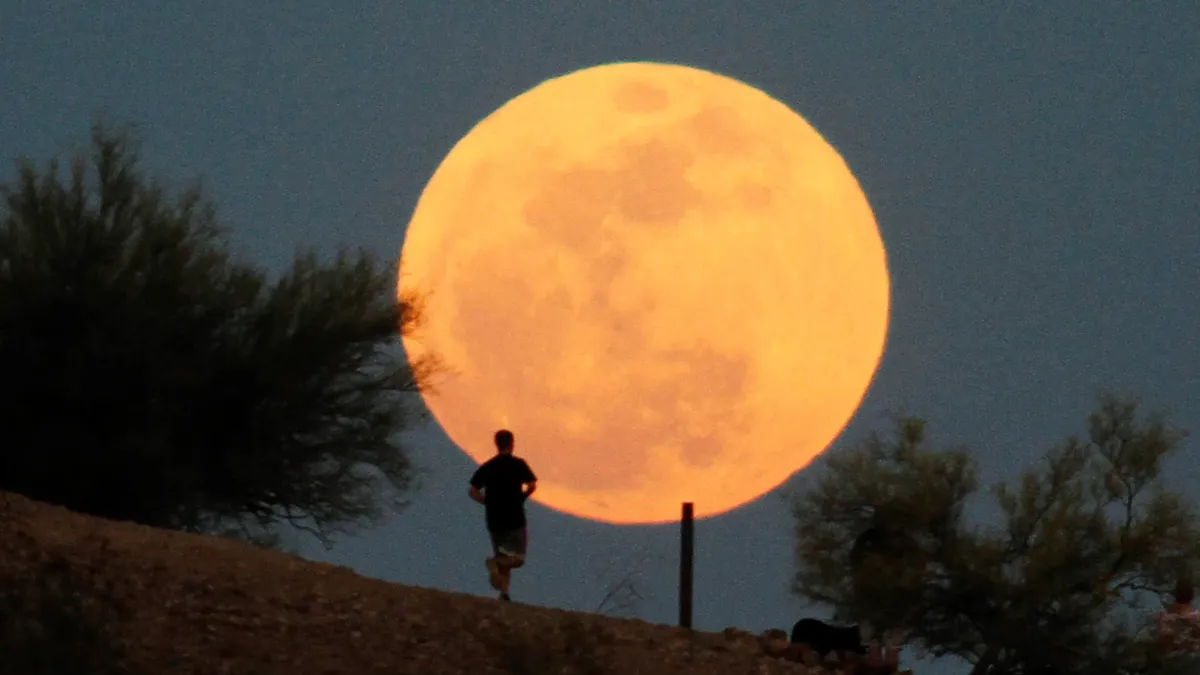
Supermoon: A popular, completely nonastronomical, term for a full or new moon that occurs at or near the time when the Moon is closest to Earth in its orbit.
A supermoon, depending on the exact distance, can appear up to about 14% larger and around 30% brighter than an average full moon, as seen from Earth.
Astronomers tend to refer more often to perigee syzygy, perigee aligned full/new moon, but “supermoon” is what caught on with the media and public discussion.
Why Does the Moon Look Bigger Sometimes?
The Moon follows an elliptical path around Earth, not a circular one. This implies that
-
Perigee: The closest point of the Moon to Earth in its orbit.
-
Apogee: The farthest point.
-
Average distance: about 238,900 miles (384,472 kilometers).
-
During the spectacular supermoon of 13 November 2016, the Moon came within just 221,524 miles (356,508 km), closer than at any time since 26 January 1948, when it came within about 30 miles of this distance.
-
When a full moon coincides with-or is very near-perigee, the Moon's apparent size and brightness increase compared with a full moon at apogee. That's what people call a supermoon.
How often do Supermoons occur?
Supermoons are not particularly rare. Because the full/new moon cycle and the perigee–apogee cycle don’t quite align, there are:
-
Several perigee full moons each year qualify as "supermoons" by commonly used thresholds.
-
Some years have 3–4 supermoons, forming a cluster of especially big and bright full moons.
-
By contrast, terms like "blue moon" (second full moon in a month) describe rarity based on the calendar, not orbital distance. A supermoon is about geometry and distance, not calendar coincidence.
Why are Supermoons so popular?
The supermoons of recent years have been social and cultural events:
-
People hold viewing parties on rooftops, beaches, or mountain viewpoints.
-
Social media fills with photos and time‑lapse videos of the enlarged Moon.
-
Some aficionados even have music playlists around the Moon and listen to "Moonshadow" or "Moon Over Bourbon Street" while watching.
-
The supermoon of November 2016 stirred this particular wave of "supermoon mania" because it was closer than any since 1948, and such proximity wouldn't occur again for decades, thus this was a must‑see event for many skywatchers.
Do Supermoons Affect Earth?
Supermoons indeed have measurable but modest physical effects.
Tides:
-
All full and new moons produce spring tides, higher high tides and lower low tides.
-
If a full/new moon occurs near perigee, these tides are higher than usual; such tides are called perigean spring tides.
Myths vs. Reality:
-
Popular claims implicate supermoons in earthquakes and volcanic eruptions, even in strange human behavior, but scientific evidence finds no strong causal connections.
-
That additional gravitational pull, relative to a normal full moon, is real but relatively small on a huge planet that is constantly experiencing tidal forces.
-
In other words, supermoons have the effect of slightly amplifying normal lunar effects, particularly on tides, without otherwise changing how Earth behaves.
How to Best Observe a Supermoon ?
Watch the Moon near moonrise or moonset when it is low on the horizon-the "Moon illusion" makes it look even bigger against buildings or trees. For maximum contrast, try picking dark locations away from heavy city lights. You don’t need a telescope, but binoculars can reveal craters and maria in more detail.
You may also like...
What is the Chemical Name of Table Salt?
What is the highest denomination note ever printed in India?






Comments
All Comments (0)
Join the conversation